


Getting into kickboxing in Dubai is easy. Finding a class worth staying at is the part that takes a bit more thought.
The city has no shortage of gyms listing kickboxing on their timetable. What varies enormously is what you actually get — whether that's a proper structured programme with qualified coaching, a fitness class with boxing gloves on, or something in between. For a complete beginner that distinction might not matter immediately, but it shows up clearly by month three when one person is developing real technique and another is doing the same cardio routine on repeat.
This guide is about making that decision well from the start — understanding the different formats available, knowing what questions to ask, and figuring out which option actually fits your goals and lifestyle.
Direct Answer: Kickboxing classes in Dubai have grown because the format delivers more than conventional gym training — real skills, genuine cardiovascular fitness, and the kind of mental engagement that keeps people training long-term rather than dropping off after a few months.
Dubai's climate pushes people indoors for training for a large part of the year. Structured, session-based formats work well here — and kickboxing fits that model naturally. Classes are time-defined, air-conditioned, and don't require you to plan your own workout.
The skill component is what separates it from most alternatives. Running on a treadmill is one thing. Learning to throw a proper roundhouse kick, building combinations, getting sharper with footwork — that's a different kind of engagement. It holds attention in a way that purely mechanical exercise rarely does past the first few months.
In communities like Arjan, Al Barsha, and JLT, the demand has grown alongside the residential population. People who might have commuted to a gym in Marina five years ago are now looking for quality training closer to home — and the facilities available locally have improved to meet that.
Not all kickboxing classes are built the same. Before signing up anywhere, it's worth understanding the main formats:
Technical kickboxing programmes are focused on genuine skill development — correct striking mechanics, defensive movement, combinations, footwork, and progressive technique-building over weeks and months. These exist at dedicated martial arts academies and serious combat sports gyms. If you want to actually learn kickboxing rather than just use it for fitness, this is what you're looking for.
Fitness kickboxing classes use kickboxing movements as a framework for cardiovascular conditioning. The emphasis is on effort and calorie burn rather than technical precision. Great workout, limited skill transfer. Most mainstream gyms and fitness studios offer this format.
Muay Thai-based kickboxing incorporates elbows, knees, and clinch work alongside punches and kicks. Common at Thai boxing academies and MMA gyms. More technically complex but more complete as a striking system. Kickboxing schools in Dubai that come from a Muay Thai lineage tend to run this format.
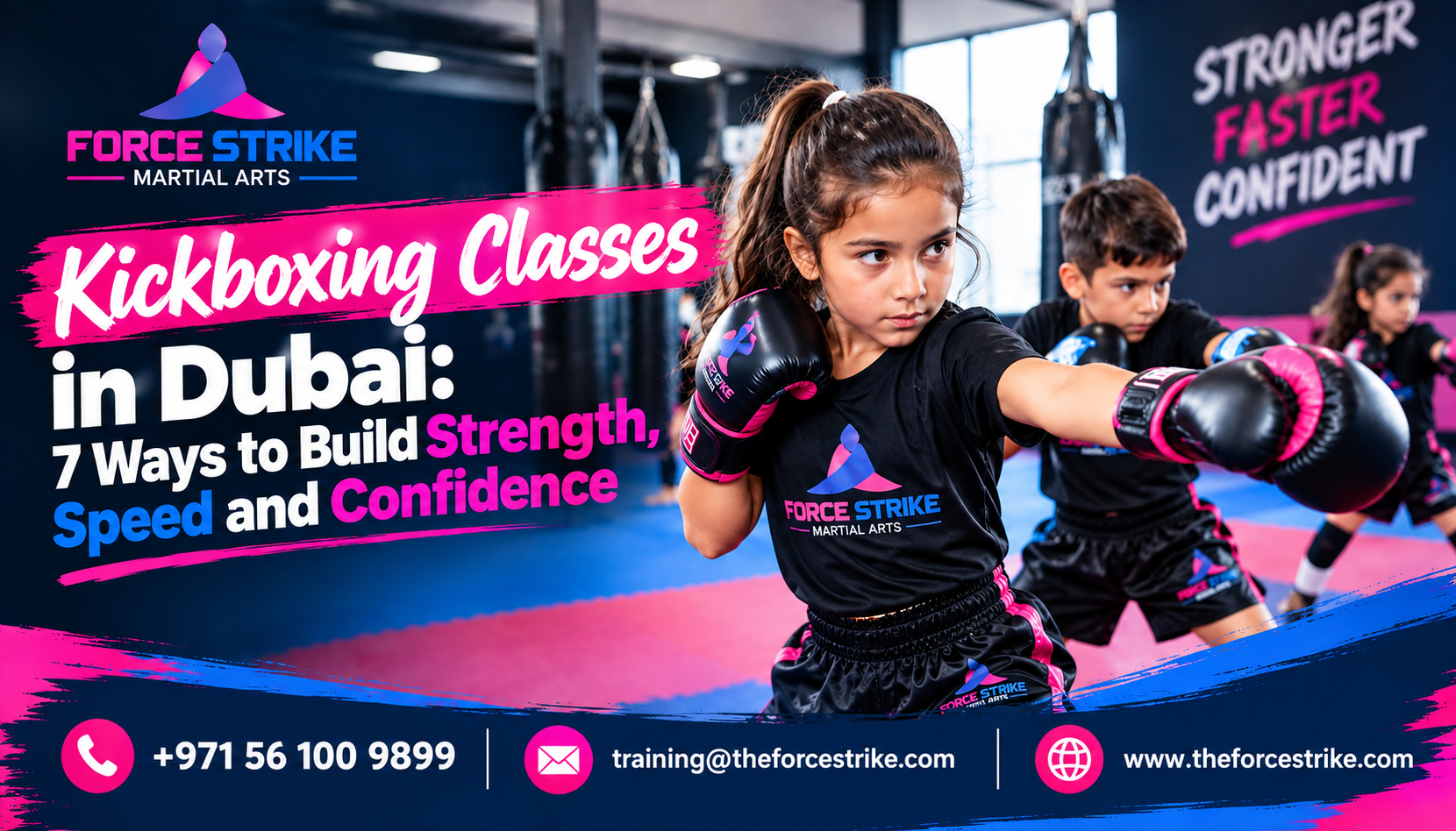
Kids' kickboxing programmes are structured around age-appropriate instruction — foundational movement, basic technique, discipline and focus outcomes. Usually run separately from adult classes with coaches who have specific experience working with children.
Knowing which category a gym is offering before joining saves a lot of wasted time and money.
Fitness only? Technical skill? Self-defence capability? Competition pathway? Kids' programme? Each points toward a different type of gym. The most common mistake beginners make is not answering this question before they start looking, which leads to ending up in the wrong format and wondering why it's not delivering.
Kickboxing near me searches in Dubai will return a long list. Filter immediately for what matters: does the gym run dedicated beginner classes or drop new students into general sessions? What are the coaching credentials? Is there a trial session available?
Proximity matters for consistency. A class ten minutes from home gets attended. One forty minutes away, even if technically better, often doesn't — especially in Dubai traffic after a full working day.
This is the single most useful thing you can do before committing. An actual session — not a promotional tour, a real class with real students — tells you everything about coaching quality, class culture, and whether the environment suits you. Most reputable gyms in Dubai welcome this. If a gym resists, that's information too.
Use it to evaluate the gym, not just the sport. Is the instruction clear? Do coaches correct technique or just motivate effort? How do existing members treat newcomers? These things predict your experience over the following months more accurately than any marketing material.
Monthly memberships: AED 350 to AED 850 depending on the facility type and location. Dedicated martial arts academies and serious kickboxing schools tend to sit in the AED 450 to AED 750 range. Multi-discipline gyms with kickboxing as one component vary more widely. Premium facilities in central Dubai push toward the higher end.
Drop-in sessions: AED 80 to AED 150 where available. Useful for trying a few different gyms before committing to any of them.
Trial sessions: Free or close to it at most reputable gyms. Always worth taking.
Kids' kickboxing: Monthly fees typically run AED 300 to AED 600 for junior programmes. Family discounts available at several gyms — worth asking directly rather than assuming.
Equipment: Hand wraps (AED 20–50) and gloves (AED 150–350) are the essentials once you're staying. Most gyms loan equipment for trial sessions. Don't invest in gear before you've confirmed the gym and format work for you.
The fitness outcomes are the obvious ones. A proper kickboxing session burns 500 to 800 calories, develops cardiovascular endurance, builds upper and lower body strength, and improves coordination. The combination of aerobic and anaerobic work within a single class is genuinely more complete than most gym-based formats.
What keeps people training, though, is usually the skill side.
There's always something to improve in kickboxing. Your jab timing, your defensive movement, how you transition between combinations, how you manage distance. That continuous skill ceiling is why kickboxing and other martial arts formats consistently outperform pure fitness classes for long-term retention. People don't quit because they've "finished" — the training keeps offering something new.
Self-defence is the other dimension that resonates specifically in Dubai. The striking mechanics, spatial awareness, and physical confidence that develop through kickboxing training are practically applicable. Not in an overblown sense — just in the real sense that trained people carry themselves differently and respond to physical situations more effectively.
For parents enrolling children: kickboxing for kids consistently produces discipline, focus, and emotional regulation outcomes alongside the physical ones. The structure of martial arts training — the respect for instructors, the progressive skill-building, the requirement to persist through difficulty — builds character in ways that most after-school activities don't reach.
|
Format |
Technical Depth |
Fitness Intensity |
Self-Defence Value |
Beginner Accessibility |
|
Kickboxing |
High |
Very High |
High |
Medium-High |
|
Muay Thai |
Very High |
Very High |
Very High |
Medium |
|
Boxing |
Medium |
High |
Medium |
High |
|
MMA |
Very High |
High |
Very High |
Medium |
|
BJJ |
High |
Medium |
High |
High |
|
Karate |
High |
Medium |
Medium |
High |
Kickboxing sits in a strong position for most beginners — technically meaningful without being as complex as MMA or as intense as full Muay Thai from the start. The striking-only format is more accessible early on than disciplines that add grappling and ground work from the beginning.
Against boxing specifically: kickboxing adds kicks and often knee strikes, which produces more complete lower body development and a broader striking range. People who want boxing specifically often train both eventually.
Letting price drive the decision. The cheapest option isn't always the worst, but a pattern of choosing cost over coaching quality tends to show up in the quality of early technique development — which is hard to correct once habits are set.
Not distinguishing fitness kickboxing from technical kickboxing. Signing up for a cardio class when you want real skill development is a mismatch that takes a few weeks to notice and is entirely avoidable by asking one direct question upfront.
Training too hard in month one. Two to three sessions per week is the right starting point. Overtraining early leads to soreness that becomes a reason to skip, which becomes a reason to quit. The body adapts quickly if given the chance — consistent moderate attendance beats sporadic intense effort every time.
Ignoring the beginner structure. Ask specifically what the first four to six weeks looks like before committing. A gym that can't answer that clearly is probably running beginners through general classes without a proper introduction.
The coaches who've been running programmes here for years tend to say the same things.
Start at the right level and stay patient about moving up. The temptation to fast-track past fundamentals is strong and usually counterproductive — the stance, guard, hip rotation, and basic combinations underpin everything else. Students who rush past them plateau faster and carry problems that take much longer to fix than they would have taken to get right originally.
Find a gym with a training culture you actually like. The people you train with determine a lot about whether you keep coming back. A technically excellent gym with a poor culture is a worse long-term choice than a solid gym where you enjoy the environment. Both matter.
For kickboxing for kids — watch a junior class specifically, not an adult one. The instructor working with children needs both technical knowledge and genuine skill at teaching young people. These are different qualifications. A great kickboxer is not automatically a good children's coach.
Dedicated beginner tracks are becoming standard at the better kickboxing schools in Dubai — structured four to eight week introductory programmes before integration into general classes. Gyms running these retain beginners at significantly higher rates than those that don't.
Women's kickboxing programmes have expanded considerably. Most serious gyms now run dedicated women's sessions or women-only tracks as standard, reflecting strong and sustained demand.
Hybrid programming — kickboxing conditioning combined with strength training — is becoming more common at multi-discipline facilities. The recognition that kickboxing alone may not address all fitness goals has pushed gyms toward more integrated programming options.
Community-level demand continues to grow in newer residential areas. Arjan, Dubai Hills, Dubailand, and similar communities are seeing local kickboxing facilities open and fill up as the residential population matures and residents stop commuting across the city for quality training.
Kickboxing classes in Dubai are genuinely worth the effort of finding the right one. The fitness outcomes are real, the skill development keeps training interesting long-term, and the self-defence and confidence dimensions add something that pure fitness formats don't provide.
The decision comes down to knowing what you want, visiting a few gyms before committing, and giving a programme enough time to show what it can do. Three months is an honest minimum. Most people who get there don't leave.
Ready to start? Find two or three kickboxing gyms in your area — whether that's Arjan, Al Barsha, JLT, or anywhere else across Dubai — take trial sessions, and watch a real class at each. One session tells you more than any article.
What are the best kickboxing classes in Dubai for beginners?
Look for gyms running dedicated beginner programmes or introductory tracks rather than dropping new students into general sessions. Coaching quality and class structure matter more than gym size or brand.
How much do kickboxing classes cost in Dubai?
AED 350 to AED 850 per month for most programmes. Trial sessions are free or close to it at most reputable gyms. Drop-ins run AED 80 to AED 150 where available.
Is kickboxing suitable for kids in Dubai?
Yes. Most established kickboxing schools in Dubai run junior programmes with age-appropriate coaching. Look specifically at the children's coach rather than the gym's general reputation.
How is kickboxing different from Muay Thai?
Muay Thai adds elbows, knees, and clinch work. Most kickboxing classes in Dubai already incorporate some Muay Thai elements. The distinction matters mainly at competitive level — for fitness and self-defence training both deliver comparable outcomes.
How often should a beginner train kickboxing?
Two to three sessions per week to start. Enough to build skill and fitness without overloading the body during the adaptation phase.
Are there kickboxing classes for women in Dubai?
Yes. Most serious gyms now run dedicated women's sessions or women-only tracks as standard. Worth confirming when you visit rather than assuming.
How long before kickboxing produces visible results?
Fitness improvements within four to six weeks. Technique development and the confidence that comes with real skill take three to four months of consistent training.