

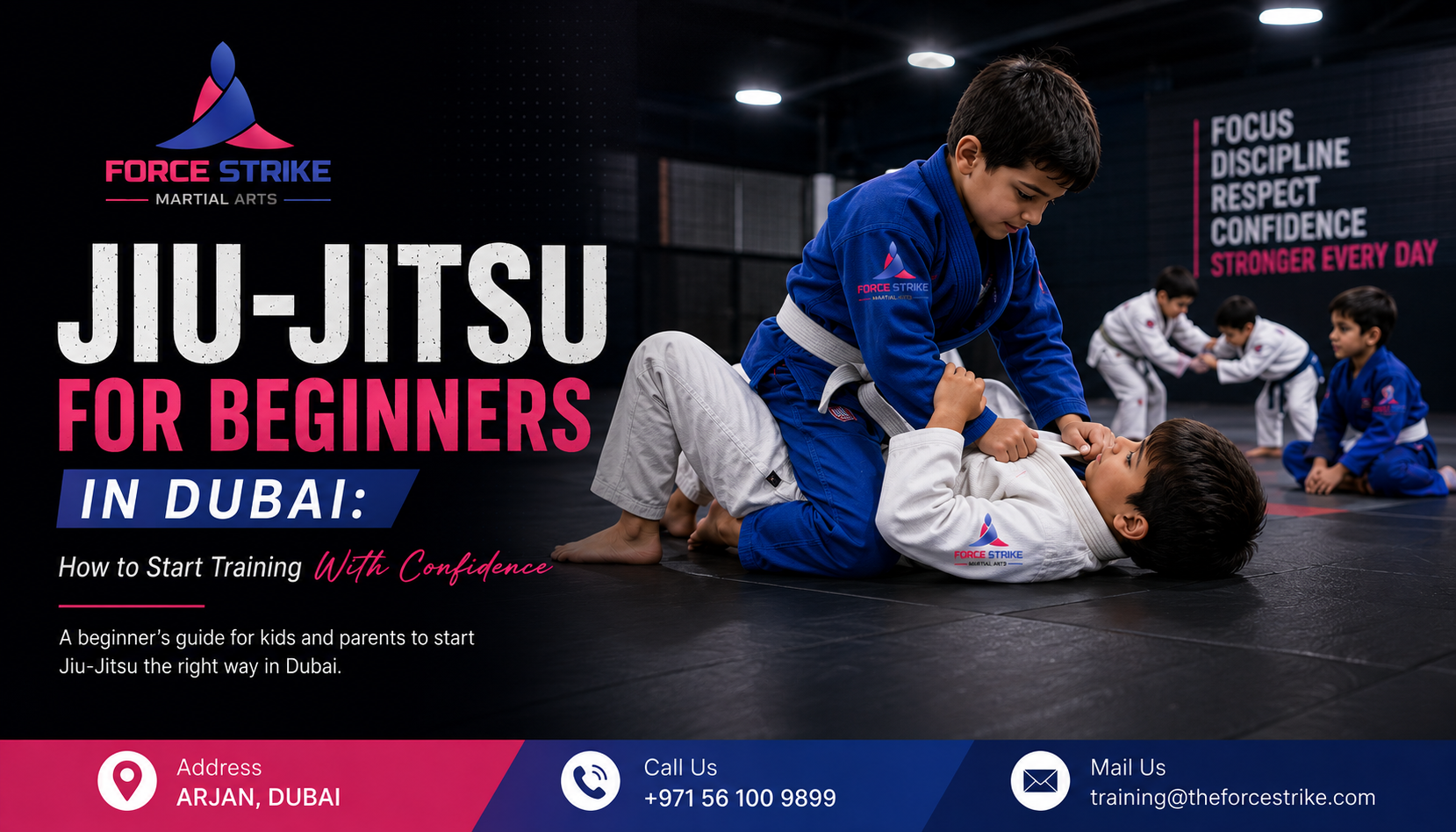
Watch a jiu-jitsu class from the sidelines for the first time and it looks like a mess. Bodies tangled up on the mat, someone tapping, a coach shouting corrections that mean nothing to you yet. If you're a parent trying to work out whether this is right for your kid, or an adult who's only ever done karate and is wondering if you'd survive a single roll, that reaction makes sense. It's also usually the wrong impression. Almost every academy builds its beginner classes around people who've never grappled before in their life. The mat stops looking so chaotic once you know how the first few weeks actually go.
That's really what this is about — what jiu-jitsu training looks like when you're brand new to it, how kids' classes differ from the adult version, and what's worth asking before you commit to anywhere in Dubai.
Jiu-jitsu is grappling, not striking. No punches, no kicks — the whole game is control and leverage, worked out while you're on the ground with another person. New students spend their first weeks on positioning and simple escapes, nothing flashy. Age and fitness matter less than most people assume walking in. A decent programme is built to take someone from knowing nothing to feeling reasonably at home on the mat, gradually, not in one terrifying afternoon.
If karate is your only reference point, the switch throws a lot of people off. Karate mostly happens at arm's length — punches, kicks, forms, stepping in and out of range. Jiu-jitsu happens close, and mostly on the ground, moving through positions like guard, mount, side control. People call it physical chess, and honestly, that's a fair description. Strength still counts for something, but a smaller, sharper practitioner can absolutely give a bigger one a hard time, which is a big part of why the sport pulls in such a mixed crowd.
What does carry over from karate is everything underneath the technique — belt progression, repetition, bowing in, respecting your training partner. That structure will feel familiar even when the movement itself doesn't.
Nobody worth training under throws a total beginner into hard sparring on day one. A typical class starts with a warm-up — footwork, breakfalls, some mobility work to loosen the body up. Then a coach shows one or two techniques, maybe an escape from a bad spot or a simple takedown, and everyone pairs off to drill it slowly, usually with little to no resistance.
Live rolling happens too, eventually. But a place that actually knows how to bring beginners along tends to ease into it rather than throwing someone straight into competitive-style sparring in week one. If an academy pushes hard rolling on a brand-new student right away, that's a red flag worth paying attention to.
This is where a lot of parents get it wrong. A children's programme isn't the adult curriculum shrunk down — good coaches spend far more time on coordination, listening, and basic movement games before any real grappling gets introduced. How that actually plays out changes a lot from one academy to the next. Class sizes, how tightly age groups are split, how much of the hour is games versus drilling — none of it is standard, so it's worth just asking a coach directly how things run for your child's age bracket.
On the safety side, a well-run kids' class tends to share a few things: age groups that are actually kept separate rather than mixed across a wide range, partner drills that stay light and closely watched, coaches who've been trained specifically to teach children rather than adults simply working a notch below their usual level, and clear rules around contact for younger belts.
No martial art can promise your child will never get hurt — that's true of most physical activity kids do, from football to the playground. What you're really checking for is whether an academy takes age-appropriate structure seriously, and whether the coach can explain how they handle contact and supervision without getting vague about it.
Here's roughly how the two compare for someone starting from scratch:
|
Factor |
Karate |
Jiu-Jitsu |
|
Main focus |
Striking, forms, stand-up technique |
Grappling, control, ground positioning |
|
Beginner intensity |
Pattern-based, moderate |
Technique-first, resistance builds up slowly |
|
Physical contact |
Controlled, at striking distance |
Close contact, most of the time |
|
What tends to draw people in |
Discipline, coordination, striking skill |
Problem-solving, control, ground-based self-defence |
No one wins outright, it's just that you don't get everything you may expect. Eventually a lot of people end up doing both. If you prefer to stay close and solve problems, rather than keeping distance and striking, jiu-jitsu may be a better choice. If you would prefer to have some space between you and your partner, then karate may be the better choice.
What to Ask Before You Sign Anything
There are a few simple questions that help to avoid unnecessary speculation. So what is the weekly beginner schedule really? Are new students grouped separately, or dropped in with more experienced ones from the start? What's the coach's background with beginners — and with kids specifically, if that applies? Can you try a class before committing to anything longer? What's actually included in the fees, and is a gi extra? And, given how close-contact the sport is, how is the mat kept clean?
An academy that answers these plainly, without dodging or just reassuring you everything's great, is usually easier to trust than one that only offers vague confidence.
Nobody looks smooth a month into jiu-jitsu. Progress here is slow and technical, not dramatic. Most beginners spend that early stretch getting used to basic positions, learning to escape before they ever learn to attack, and building a kind of fitness that's specific to grappling — different from general gym fitness, even for people who already train elsewhere. There's also just a lot to pick up around mat etiquette: how drilling actually works, when it's your turn to roll, who you ask if you're unsure about something.
Feeling awkward during this stretch doesn't mean the sport isn't for you. It means you're new. Showing up consistently over the first couple of months matters far more than any natural athletic ability.
Dubai isn't short on martial arts options. Search around for jiu-jitsu classes in the city and you'll notice academies scattered across Arjan, Al Barsha, JVC, Motor City, and a handful of other neighbourhoods. For someone just starting out, how easily a class fits into your actual week matters almost as much as who's teaching it — staying consistent gets a lot harder when the schedule fights against your daily routine.
Forcestrike Martial Arts is one of the academies training jiu-jitsu in this part of Dubai, alongside other martial arts disciplines. Whichever place you're considering, the same advice holds: go see it in person if you can, ask about a trial class, and pay attention to how the coaches talk to complete beginners before you commit to anything longer term.
A handful of concerns show up again and again, especially from people crossing over from a striking background.
"I'm not flexible or fit enough for this." That comes with training, not before it. Beginner classes are usually paced for a wide range of starting fitness levels, not just people who show up already in shape.
"Do I have to spar right away?" Not usually. A lot of beginner programmes hold off on live rolling, or keep it very light, until a new student has some grasp of basic defence and safety.
"Is this actually safe for my child?" Youth programmes generally lean toward controlled, age-appropriate training rather than anything resembling adult sparring. It's a completely fair question to put to a coach directly — and how they answer it tells you a lot about how the whole academy is run.
There isn't a correct age or moment to start jiu-jitsu. Some kids start at four. Some adults pick it up in their forties looking for a new challenge, a practical self-defence skill, or just something different from the gym routine. What matters more than timing is whether the class actually feels welcoming to someone brand new — coaches who'll explain the basics patiently instead of assuming you already know them.
If you're a parent, or a karate beginner weighing this up, a trial class is probably the most useful next step you can take. It'll tell you more about coaching style and whether the place feels right than any amount of reading ever will, and it doesn't lock you into anything.
If you're in or around Arjan and thinking about jiu-jitsu, whether for yourself or your child, Forcestrike Martial Arts runs jiu-jitsu classes across a range of ages and experience levels. Getting in touch directly is the best way to ask about a trial class, current schedules, and what a beginner programme actually involves.
Is jiu-jitsu suitable for someone with zero martial arts background?
Yes. Most academies have their beginner classes based on people who have never grappled before, focusing on positioning and movement before advanced techniques are introduced.
What age can kids start jiu-jitsu?
Varies depending on the academy but there are quite a few that operate children's programmes around the age of four or five and the class is tailored to the age group. Check directly with the academy you are interested in.
Do I need to already be fit before I start?
No — that tends to build up through training itself. Beginner classes are usually paced for a range of starting fitness levels.
How is jiu-jitsu actually different from karate, day to day?
Karate is mostly stand-up and striking-focused. Jiu-jitsu is almost entirely grappling and ground control. Both use belts and structured progression, but what happens on the mat looks quite different.
Is jiu-jitsu safe for kids?
No contact sport comes with a zero-risk guarantee. But well-run youth programmes tend to use age-appropriate grouping, close supervision, and coaches specifically experienced with children. Worth asking a coach directly how they handle this.