

Ask a parent why they're looking into martial arts and you'll usually get some version of the same story: the kid can't sit still, doesn't listen the first time you ask, needs somewhere to put all that energy that homework clearly isn't absorbing. Ask an adult and the reason shifts a bit. They want to get back in shape, the gym never really stuck, and something with actual structure sounds more bearable than another solo treadmill session that goes nowhere.
Kung Fu classes Dubai land somewhere in the middle of both of those needs. It isn't a fix-all for either problem — how much it helps comes down to the school, the coaching, and honestly, whether you keep showing up. This piece goes through what a Kung Fu class actually looks like, what people tend to notice happening to their fitness and focus over time, and what's worth checking before you sign up, whether that's for a child or for yourself as a complete beginner.
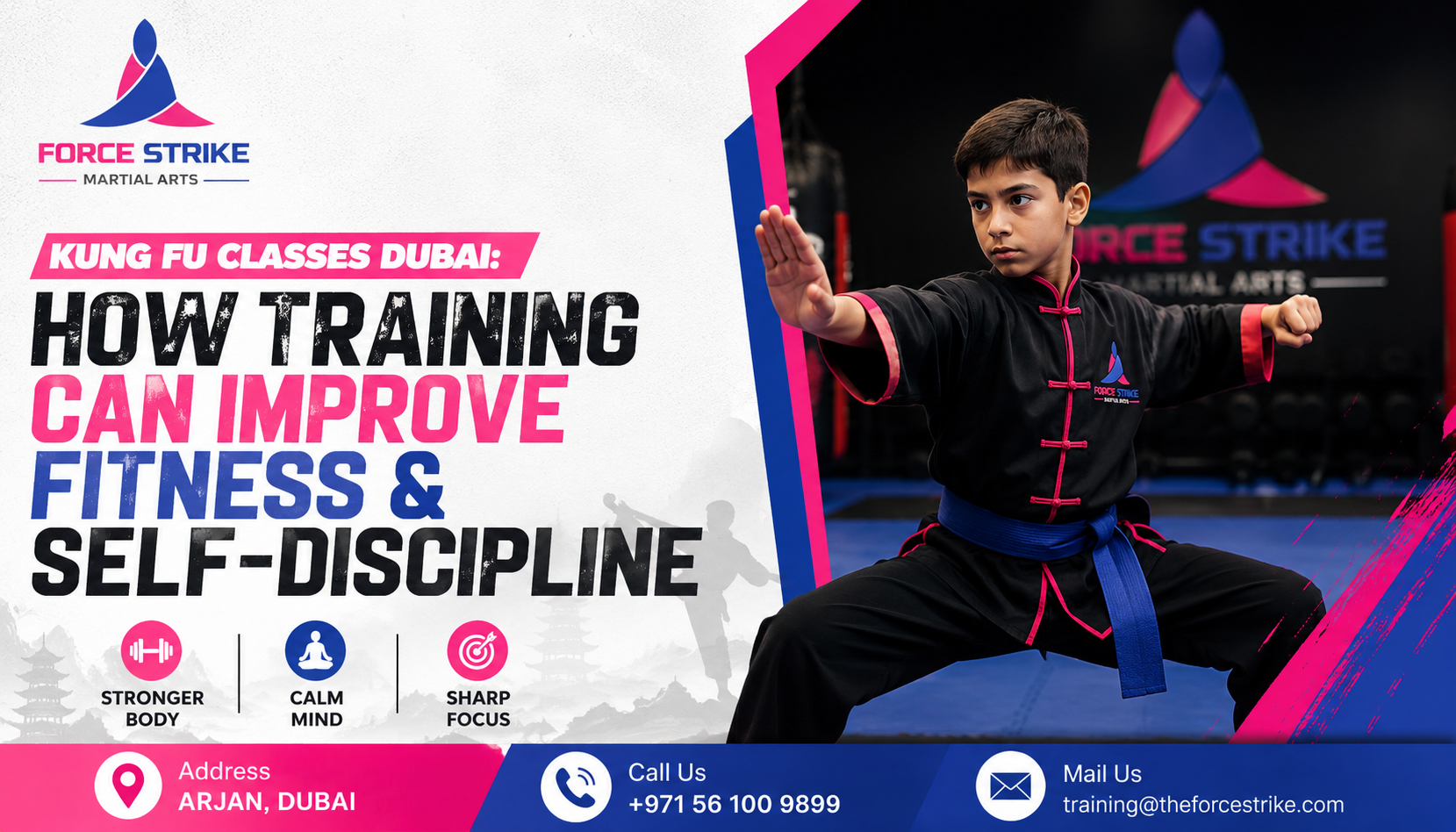
Take away the film choreography and a Kung Fu training Dubai comes down to striking, footwork, stance work, and forms — sequences of movement students learn and repeat until the body just knows them. Train regularly and most people start noticing better cardiovascular fitness, coordination, strength, and flexibility. Discipline tends to build on a similar timeline. Turning up, following instructions, drilling something until it's right — none of that happens after two sessions. It's slow, and how much sticks depends on the person, their age, and how often they actually train.
Most people picture Kung Fu through cinema — fast strikes, gravity-defying kicks, dramatic weapon work. Real classes are a lot less theatrical than that. A session usually starts with a warm-up, moves into stance and footwork drills, works through striking or blocking practice, then closes with some form of pattern training — often called forms, or taolu.
Depending on the style and the school, there might be partner drills mixed in, some light contact work, or plain conditioning like squats and core exercises. A handful of schools bring in basic self-defence applications once the fundamentals are solid, though that tends to come later, not in the first month. Worth remembering too — Kung Fu isn't one fixed system. It's more of an umbrella term for dozens of different styles, so what gets taught at one academy can look genuinely different from what's taught somewhere else across town.
The physical side tends to show up earliest, mostly because a Kung Fu class rarely has anyone standing still for long. Regular students often notice better cardiovascular endurance fairly quickly — striking combinations and constant footwork push the heart rate up in a way that isn't far off interval training. Flexibility tends to follow, particularly through the hips and legs, since a lot of styles rely on kicking and lower stances.
Then there's strength, which catches people off guard if they've assumed martial arts is all technique and no muscle. Try holding a horse stance for even thirty seconds and you'll feel exactly where your legs and core stand. And because Kung Fu asks the body to coordinate footwork, hand technique, and rotation all at the same time, balance tends to improve almost without anyone trying for it directly.
None of this runs on a fixed schedule, though. Someone training twice a week is going to see different results than someone training every other Sunday, and starting fitness plays into it too. It's progress — not a formula you can plug numbers into.
"Discipline" gets used a lot in martial arts marketing, often vaguely. In practice it mostly just means structure. Bowing in at the start, listening before moving, repeating a technique until the coach is happy with it, waiting your turn in line — these small routines, repeated often enough, are what actually build the habit. For kids, that structure has a way of showing up somewhere unexpected, like sitting through a school lesson, or following a three-step instruction the first time without needing it repeated twice.
Adults experience it a bit differently. It's less about sitting still and more about turning up on a Tuesday evening when the sofa is genuinely more appealing, or sticking with a technique you keep getting slightly wrong until it finally clicks. That kind of consistency is harder to manufacture alone than it is inside a class, with a coach watching and other students around you doing the same drill.
Children's Kung Fu classes tend to be structured differently from adult classes – shorter drills, more games incorporated into the lessons, more focus on listening and co-ordination than sparring. In a school that cares, a six-year old and a twelve-year old must not be in the same class. It's good to ask the school a few questions before you register a child. In fact, how are the classes divided — by skill level or age? So, how would a typical session be for the younger children? When and how is contact/sparring introduced? During a class, how many coaches are on the floor? How does the school deal with a child who has never participated in a formal programme similar to this? Policies vary across academies, so it's not wrong to ask, it's not right to assume!
Parents and adult beginners often weigh Kung Fu against Karate, Kickboxing, or Brazilian Jiu-Jitsu before picking somewhere to start. Each one is training something a little different.
|
Aspect |
Kung Fu |
Karate |
Kickboxing |
Brazilian Jiu-Jitsu |
|
Primary focus |
Forms, striking, fluid movement |
Striking, structured belt system |
Striking, cardio-heavy |
Grappling, ground control |
|
Contact level |
Varies by school |
Typically light to moderate |
Moderate to high |
Controlled, close contact |
|
Beginner-friendly |
Yes |
Yes |
Yes |
Yes, with patient coaching |
|
Common draw for kids |
Discipline, coordination, forms |
Structure, belt progression |
Energy release, fitness |
Problem-solving, control |
It isn't really about which one is "better," whatever the marketing implies. Someone who likes pattern-based learning and continuous movement will probably get more out of Kung Fu than a rigid belt system. Someone who wants clear, visible milestones might prefer Karate instead. There's no single right answer here — it comes down to what actually keeps a person, or a kid, engaged enough to keep showing up.
Not every Kung Fu school in Dubai runs things the same way, so a bit of digging before you enrol — yourself or your child — tends to be worth the time.
Look into how classes are supervised, especially for a children's programme, and ask what the coach-to-student ratio really is, not just what the brochure says. Most academies offer a trial class, and taking one is probably the single most useful thing you can do before committing to anything longer. It tells you more about coaching style and pace in forty minutes than a website ever will. Class size and age grouping matter here too — smaller groups usually mean more individual correction, which counts for a lot when someone's still working out the basics.
Then there's the unglamorous stuff people tend to underrate: does the schedule actually fit your week, and how far is the academy from home, school, or work, realistically. A class that's easy to get to beats a "better" one that's forty minutes across town, mostly because you'll actually keep going to the first one. Last thing worth asking — how the school handles contact training and protective gear, particularly for kids or anyone brand new to physical training of any kind.
A few patterns show up often enough to be worth naming. Expecting results after two or three classes is probably the most common one — fitness and discipline build slowly, and judging progress too early usually just leads to giving up. Skipping the fundamentals is another. Stance work feels repetitive and, frankly, a bit boring at first, but it's the base everything else in Kung Fu is built on.
Inconsistent attendance quietly undoes more progress than people realise. Training once every few weeks isn't really enough to build muscle memory that sticks. And comparing your own pace — or your kid's — against someone else in class rarely helps anyone. People start from completely different places, in terms of coordination, prior fitness, and how much they actually practise outside the studio.
For families based around Arjan, how close the academy actually is tends to decide whether Kung Fu classes for kids turn into a real habit or quietly fade out after a month. A short drive that fits around school pickup or the tail end of a workday is a lot easier to stick with than a longer commute across the city — even when the class itself is genuinely good. Same logic applies to anyone training from other parts of Dubai. Location, schedule, and coaching style all matter, and getting the combination right usually beats chasing any single factor on its own.
If you're still deciding on Kung Fu classes in Dubai, the most useful next move is probably a trial class rather than more reading. Watching a session run — how the coach talks to students, how a nervous adult beginner or a fidgety six-year-old gets handled — tells you more in forty minutes than any amount of research will. Forcestrike Martial Arts runs Kung Fu training for kids and adults, with classes organised by age group and experience level.
If Kung Fu classes in Dubai sound worth trying — for you or for your child — the most reliable way to find out is by sitting in on a class, not reading about one. Get in touch with Forcestrike Martial Arts to ask about trial class availability and find a schedule that actually fits your week.
Is Kung Fu suitable for someone with no martial arts background at all?
Yes. Beginner classes are usually built around fundamentals — stances, basic strikes, simple forms — so prior experience isn't expected or assumed.
What age can kids start Kung Fu classes?
It varies by school. Many academies open their children's programmes around ages 4 to 6 and split from there by age and ability. It's worth confirming directly with the school, since groupings genuinely differ.
How often do you actually need to train to see results?
Once or twice a week is typical for beginners. Most people start noticing changes somewhere between a few weeks and a couple of months in, but that timeline moves depending on the person.
Is Kung Fu safe for children?
It can be, as long as classes are age-appropriate, properly supervised, and contact gets introduced gradually rather than too early. It's reasonable to ask any school directly about supervision ratios before enrolling.
Do you need to be fit before you start?
No. Classes are generally structured to work with whatever fitness level someone walks in with. Conditioning builds through the training itself, not before it.