


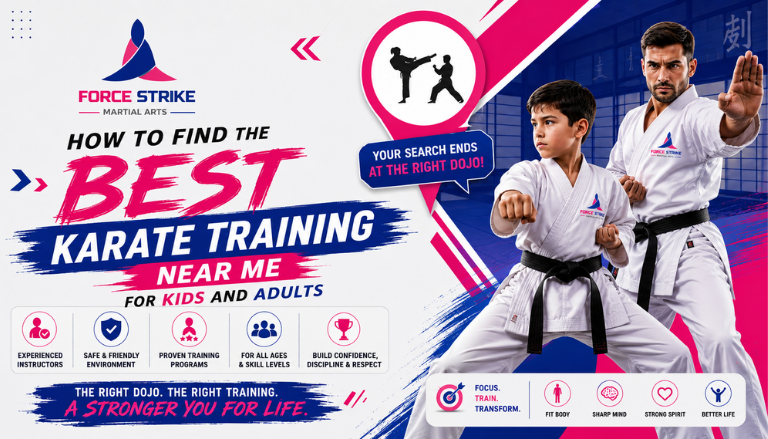
If you've typed "karate training near me" into Google more than once this month, you're past the curiosity stage. You want a real answer — which dojo, which schedule, roughly what it costs, and whether it's worth giving up your Saturday mornings, or your kid's after-school hours, to actually go.
I've spent enough years around martial arts programs in Dubai to notice a pattern: what makes a parent stick with a school for three years, versus quitting after three weeks, is almost never the flashiest website or the biggest Instagram following. It's a handful of boring, practical details that nobody thinks to check until they've already wasted a term's fees finding out the hard way.
This guide walks through what those details are, with Arjan as the reference point, since it's quietly become one of the more active pockets in Dubai for martial arts training.
Nobody searches "karate places near me" just to find a pin on a map. There's usually a stack of unspoken questions underneath it: is this place safe for a five-year-old, does the instructor know what they're actually doing, can I fit this into a week that's already full, and — the one parents rarely say out loud — will my kid even stick with it past month two?
A dojo worth your time answers most of that before you've had to ask. If the front desk can't tell you who's teaching, what belt system they follow, or how classes are structured, that's already telling you something.
Dubai's martial arts scene has grown a lot since it was mostly a handful of gym add-ons a decade back. Today, options tend to split into three rough buckets.
There are community and fitness-center programs — usually Karate Classes in Dubai bolted onto a regular gym's schedule. Convenient if you're already a member, though the instructor teaching it can change from month to month.
Then you've got dedicated martial arts academies, built specifically around karate (sometimes alongside other disciplines), with a fixed head instructor and an actual belt progression system that's tracked and taken seriously.
And finally, school-based after-school programs, which work well purely on convenience — no extra driving, fits the school calendar — but generally go less deep than a standalone dojo would.
For most families I've seen make this decision, a dedicated academy ends up being the better long-term fit. It's not that gym classes are bad, exactly. It's that once a kid gets past the first few months and starts actually caring about their belt rank, the structure of a real academy tends to matter more.
Ask about instructor credentials first. What style is being taught — Shotokan, Kyokushin, Goju-Ryu, something else — and what rank does the head instructor actually hold? A legitimate school answers this without hesitation. If you get a vague answer, keep asking.
Then go watch a class before you sign anything. Photos on a website tell you nothing. Sit in for ten minutes and just watch whether the kids look engaged, or whether they're going through motions because that's what's expected.
Class size matters more than people assume — anything past 15 to 18 students per instructor starts making individual correction difficult, and that's exactly the stage where beginners need the most hands-on feedback.
Ask, too, about the grading calendar. A school that has a real, structured belt-testing schedule (not "whenever we get around to it") is one that takes the actual craft seriously, not just the enrollment fees.
Safety and supervision is worth a direct question as well — mats, first-aid readiness, and a clear pickup and drop-off protocol. Nobody thinks about this until something goes wrong, and by then it's too late to ask.
Last step, and honestly the most important one: trial a class before committing to anything. Nearly every serious academy offers this. If a school pushes you toward a long contract before you've even watched a session, take that as a red flag rather than a sales tactic to push past.
|
Factor |
Community/Gym Class |
Dedicated Academy |
School Program |
|
Instructor consistency |
Variable |
High |
Moderate |
|
Belt progression structure |
Often informal |
Formal, tracked |
Basic |
|
Class size |
Larger |
Small to moderate |
Large |
|
Cost |
Lower |
Moderate to higher |
Included in tuition/fees |
|
Schedule flexibility |
High |
Moderate |
Low (fixed school hours) |
|
Best suited for |
Casual fitness interest |
Serious, long-term training |
Convenience, younger kids |
Arjan has become a decent spot for this kind of training, and it's mostly down to how the community is built rather than anything flashy.
Parking, for one, is manageable near most residential clusters — which matters more than it sounds, on an evening when you're doing school pickup and karate drop-off within the same hour and don't have twenty minutes to spare circling for a spot.
Because Arjan skews toward younger families, a lot of local programs schedule around typical school timing — late afternoon on weekdays, mid-morning on weekends — rather than the evening-only slots you'd see in more commercially dense areas.
There's also a genuine word-of-mouth culture here. Parents in Arjan tend to cross paths through schools and community WhatsApp groups, so it's worth actually asking around locally before you commit anywhere — you'll usually get a straighter answer from another parent than from a sales page.
One thing that isn't optional, given the climate: make sure the training space is properly air-conditioned indoors. This sounds obvious, but it's worth confirming directly rather than assuming, especially for facilities that market themselves as having outdoor or semi-outdoor space.
Forcestrike Martial Arts is one of the options training out of this area, running structured karate programs for both kids and adults with more of a discipline-first approach than a pure fitness-class feel. If you're comparing karate classes near me specifically within Arjan, it's a reasonable one to put on your shortlist alongside whatever else you're considering.
The most common one, by far, is choosing based purely on how close a dojo is. The nearest option isn't automatically the right one — an extra fifteen minutes in the car for a genuinely well-run program is usually worth it in the long run.
Skipping the trial class is a close second. Committing to a full term, sight unseen, is how most dropouts happen. It's an easy step to skip when you're busy, and it's almost always the one people regret skipping.
There's also a tendency to underestimate how much consistency actually matters. Karate is built on repetition — training once every couple of weeks won't produce visible progress, and kids notice the lack of progress faster than adults expect, which is usually what kills motivation before the six-month mark.
Ignoring the instructor-to-student ratio is another one. A packed, high-energy class photographs well, but it usually means less individual correction, and that's precisely what beginners need most in the first six months.
And finally: assuming all karate styles are basically interchangeable. Shotokan, Kyokushin, and Goju-Ryu differ meaningfully in contact intensity. What suits a competitive fifteen-year-old could genuinely overwhelm a nervous six-year-old on their first day.
Karate is a great choice for children ages 5+ who may need a little more discipline, focus and basic co-ordination and for adults who need some discipline and some mental and self defence added to their structured fitness. It's also a good option for anyone trying to rebuild their self-esteem, as once you get the belt, you get a sense of leveling up. Families who seek one activity that will suit more than one age level will often find this one to be successful as well.
In contrast, children aged under four are not likely to have the attention span of the structured classes, which means to wait is often better. It is important that individuals with an untreated joint or back problem speak to a doctor before beginning. And if the goal is walking in and being able to defend yourself within a few sessions, that expectation needs adjusting — karate builds that kind of competence over months, not weeks.
Pricing in Dubai varies more than people expect, and a few things drive most of that variation: how often you're training (once weekly costs noticeably less than three times a week), whether it's group or private instruction (private runs considerably higher), and grading or belt-test fees, which are almost always charged separately from the monthly tuition.
Uniform and equipment costs are usually a one-time expense, though they'll need updating occasionally as a kid grows out of theirs. Registration or trial fees are often waived for that first session anyway.
The more useful comparison isn't the headline monthly price — it's what's actually included. A school that looks cheaper on paper can end up costing more over a year once grading fees and uniform replacements are factored in.
A few shifts worth knowing if you're enrolling this year. Academies are increasingly framing karate as a mental-focus and screen-time-balance tool for kids, not purely a fitness class — that positioning has become more common than it was even a couple of years ago. Class sizes, at least among academies trying to differentiate on quality, are trending smaller rather than larger, as demand for individual attention grows.
Adult beginner enrollment also seems to be climbing — more adults starting from zero rather than just signing their kids up, often citing stress management as much as fitness. And trial-first enrollment models are becoming the norm rather than the exception, which reflects a more comparison-shopping, better-informed parent base than existed a few years back.
It's not the quality of the Dojo that is being looked for.It's not the quality of the dojo that is being sought after. It's about finding the teacher who is the best fit for you or your child, the class that's the right size, and the time that they can attend, then continuing through the class until you get the results you're looking for.
If you are in or around Arjan, as an extra week, consider sitting in on a class and have some direct questions about who is teaching, and obtain a trial session before committing to anything longer. The additional step is typically what makes the difference between families that still have a child in training three years later, and those families that simply stopped two weeks later.
Want to see a class in action first? Reach out to a local academy like Forcestrike Martial Arts to book a trial session before committing to anything longer term.
Is karate good for young kids?
Generally yes, from around age five. Younger than that, and most children don't yet have the attention span structured classes need.
How many days a week should a beginner train?
Two sessions a week is roughly the minimum for progress you'd actually notice within a few months.
Do I need a uniform before starting?
No — most schools are fine with regular workout clothes for a trial, and only require a gi once you formally enroll.
Is karate actually useful for self-defense?
Eventually, yes, but it takes months of consistent training to get there. It's not something a handful of classes will produce.
What's the real difference between karate styles?
Mainly contact intensity and technique focus. Shotokan, Kyokushin, and Goju-Ryu aren't interchangeable, and it's worth asking which one a school teaches before enrolling a younger or more sensitive kid.
How do I check if an instructor is actually qualified?
Just ask — their rank, who certified them, how long they've been teaching. A legitimate instructor won't dodge the question.