


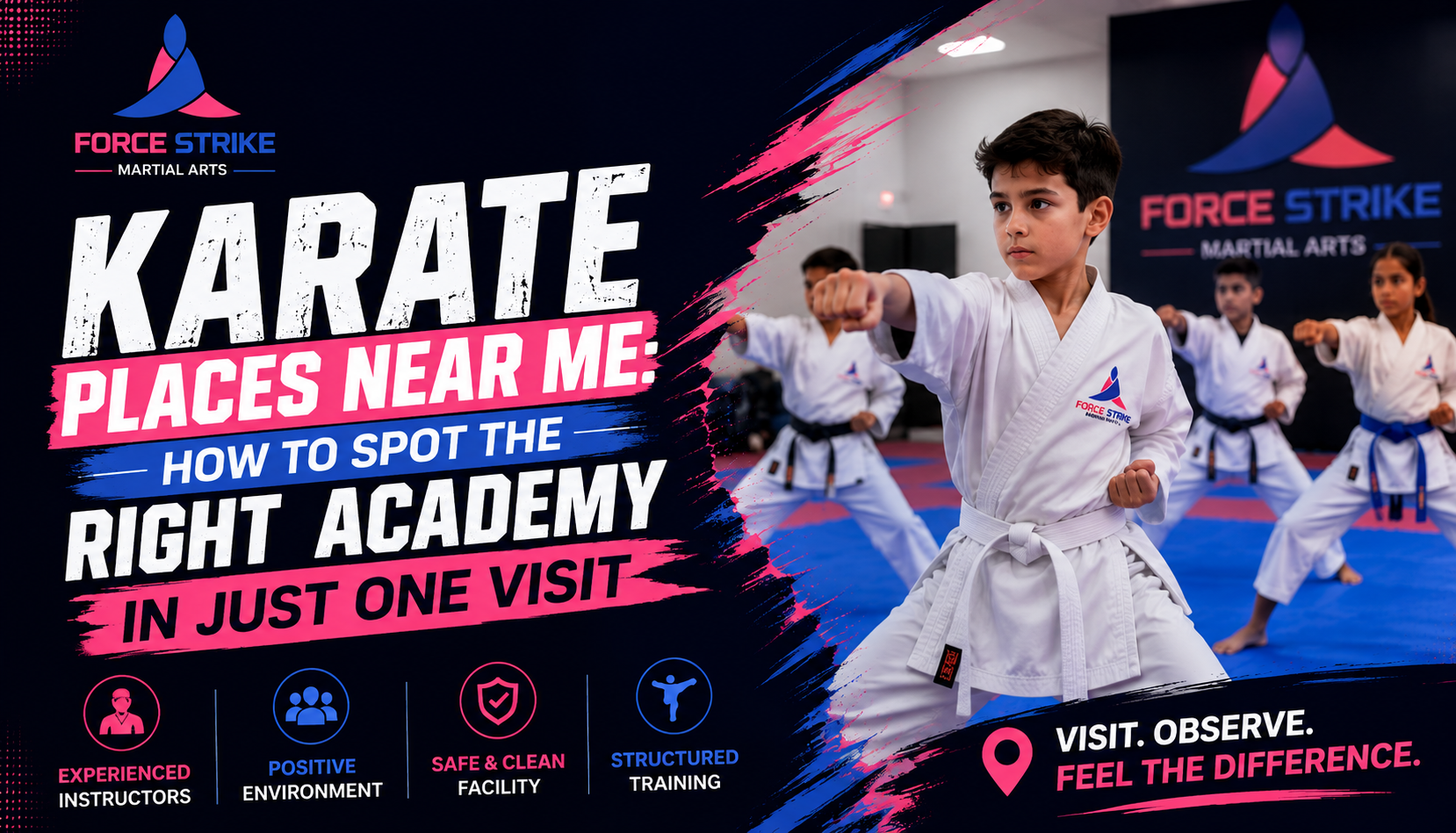
Typing "karate places near me" into Google usually means you're past the curiosity stage. You've probably already decided karate is a good idea for your kid — maybe they've got too much energy for a normal Tuesday, maybe a teacher mentioned they could use more confidence, or maybe a friend's child did it and came back a completely different kid. Now you just need to find the right place.
Here's something most parents don't figure out until they've already sat through three or four disappointing trial classes: you can usually tell if an academy is right within a single visit. You just have to know what you're actually watching for, because a lot of it isn't obvious from a website or a phone call.
Nobody typing "karate training near me" is just looking for the closest pin on a map, even though that's how the search reads. Distance matters — nobody's driving 40 minutes across Dubai twice a week for long — but it's the smallest part of the decision.
What actually decides whether your child sticks with this for two years instead of quitting in October is the instructor. Full stop. You could have the best-located dojo in Arjan, and it won't matter if the person running the room doesn't know how to talk to a nervous eight-year-old.
Skip the sales pitch and pay attention to the room instead.
Watch how the instructor treats the newest kid. A decent sensei slows down for a beginner without making everyone else stand around waiting. If a child fumbles their stance and gets a shrug — or worse, a laugh — that's worth remembering on the drive home.
Pay attention to the room's energy. Focused and a little intense is normal for karate. Chaotic isn't. A lot of the karate classes in Arjan Dubai fill up with total beginners, so the good academies are the ones that can hold structure even when half the room has never thrown a punch before.
Count how much time is spent talking versus doing. If the instructor is lecturing for most of the hour, kids check out fast — and honestly, so would you. You want short corrections and a lot of repetition.
And ask directly about belt progression. Some places move kids up quickly just to keep parents happy, which sounds nice until you realize it means nothing. Ask: "What does a student actually need to show before moving up a belt?" If the answer is vague, that tells you something.
Bring your child to the trial even if they're shy or hesitant. How the instructor pulls a quiet kid into the group in the first ten minutes says more than anything on the academy's Instagram page.
|
Factor |
Structured Academy Classes |
Home / Online Training |
|
Discipline & Structure |
High — real dojo etiquette |
Hard to enforce consistently |
|
Social Development |
Kids train alongside peers |
Basically none |
|
Live Correction |
Instructor adjusts in real time |
Delayed, if it happens at all |
|
Belt Progression |
Structured and recognized |
Often informal, self-graded |
|
Cost |
Moderate monthly fee |
Cheaper, but limited value |
|
Consistency |
Fixed schedule builds a habit |
Too easy to skip |
For most families here, particularly with kids under 12, in-person training wins. Karate isn't really about the kicks and blocks — it's the discipline and the social piece that make it stick.
Picking based on price alone is the big one. The cheapest option usually cuts corners somewhere — instructor experience, class size, sometimes both.
Skipping the trial class entirely is another. Signing up off a phone call or a nice-looking website means you find out about problems after you've already paid.
Ignoring the actual commute is a quieter mistake. A dojo that looks perfect on paper but means fighting traffic twice a week rarely survives past month two — for the parent, not the kid.
Parking gets overlooked too. In a community like Arjan, an easy drop-off routine matters more for long-term attendance than people expect going in.
And a lot of parents never actually ask about instructor credentials. Charisma isn't the same thing as qualification. Ask about their training lineage and any coaching certifications — a good academy will answer this without hesitating.
Kids under four usually don't have the attention span structured karate needs — a movement-based pre-karate program fits better at that age. Anyone recovering from a recent injury should get medical clearance first. And if you're expecting fast results, karate isn't really built for that. It rewards patience more than speed.
Monthly fees around Dubai shift based on how often classes run, how experienced the instructor is, and whether it's a standalone dojo or part of a bigger sports facility. Beyond the base fee, ask about:
If an academy lays all of this out during your first visit instead of introducing surprise costs later, that's usually a good sign about how they run things generally.
Academies across Dubai have been moving away from large, one-size-fits-all classes toward smaller, more personalized coaching groups. There's also more attention going into tracking actual progress — some places now share notes with parents after each grading cycle instead of leaving it a mystery. And community-focused academies, especially in family-heavy areas like Arjan, are increasingly building schedules around school hours and weekend routines instead of expecting families to bend around the dojo.
Picking the right karate academy isn't about the nearest option or the best website. It comes down to watching how an actual class runs and how the instructor handles a room full of beginners. One well-observed trial class tells you almost everything you need to know before you sign anything.
If you're in Arjan or nearby and want to see this approach in action — structured classes, patient instructors, and an actual sense of community — Forcestrike Martial Arts is worth a visit. Sit in on a class, ask the questions above, and see for yourself.
How do I find good karate classes near me in Dubai?
Shortlist two or three academies within a manageable commute, then sit in on trial classes at each before deciding anything.
What age should a child start karate?
Most places recommend starting around 5-6, though some run foundational programs for younger kids.
How often should kids train?
Twice a week is fairly standard — enough for steady progress without burning a beginner out.
Is karate a good fit for shy or anxious kids?
Often, yes. The gradual, structured progression tends to build confidence slowly, especially with a patient instructor.
How long does it take to get a black belt?
It varies a lot, but 3-5 years of consistent training is typical.
Are karate classes in Arjan Dubai easy to get to?
Depends on the academy — worth confirming parking and access before you commit to a weekly schedule.