

Sunday evenings at most Dubai gyms tell the same story. The treadmills fill up fast. The squat rack sits empty until someone who's clearly been training a while wanders over. New members almost never touch it first, and honestly, I get why — a barbell looks a lot scarier than a machine with a start button.
I've coached this exact hesitation out of hundreds of beginners at Forcestrike Martial Arts, and there's a pattern that shows up again and again: the ones who last past month three almost always spent their first few weeks on strength basics, not cardio. Not because strength is trendy right now. Because it's the thing that keeps everything else from falling apart later — whether "everything else" is a fitness class, a martial arts session in Arjan, or just being able to carry your kid up the stairs without your back complaining.
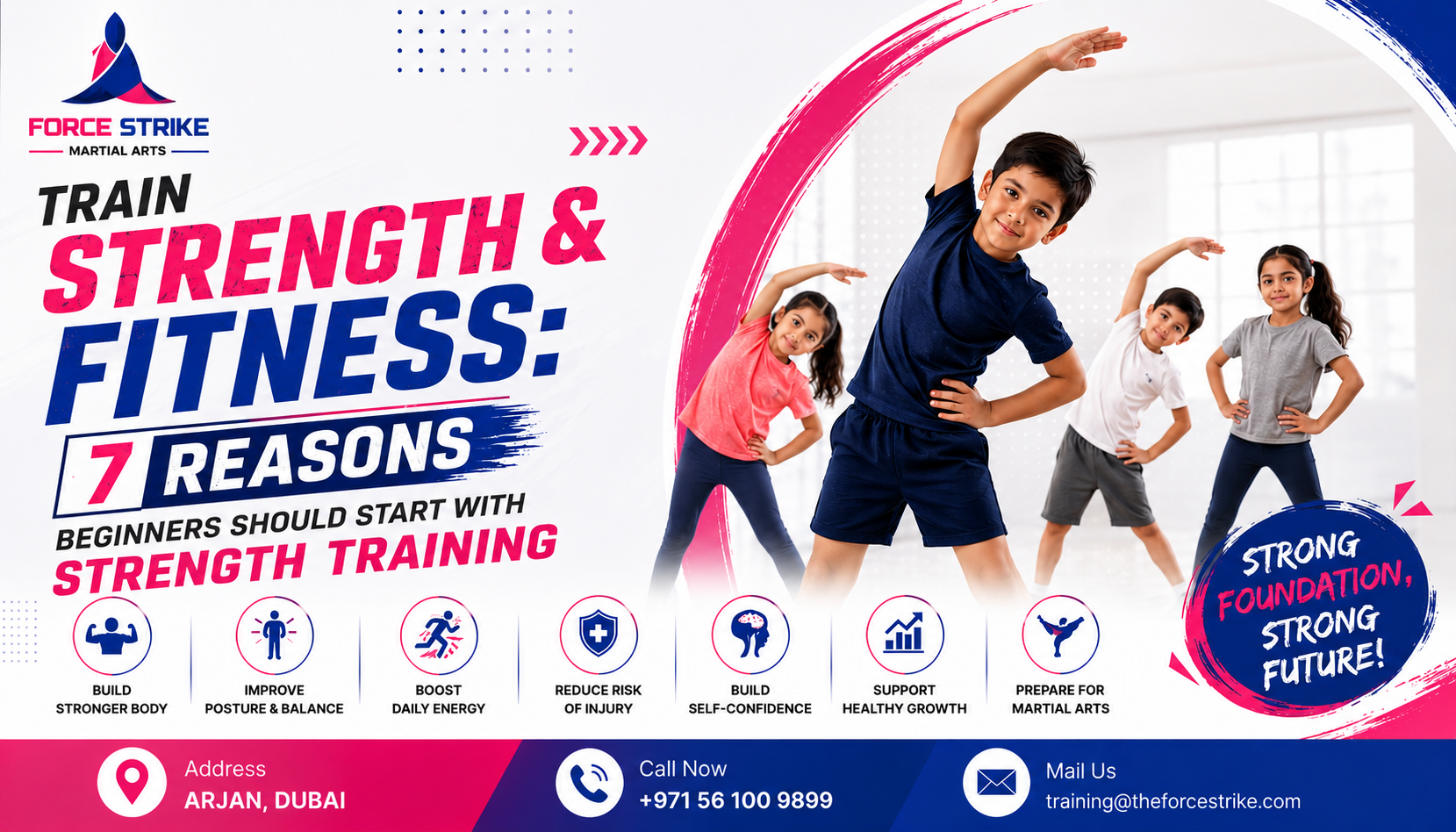
Train strength & fitness training first, cardio second — that's the short version. It builds the joint stability, coordination, and tissue resilience that every other goal quietly depends on, whether that's fat loss, endurance, or holding your own in a sparring session. Cardio raises your heart rate. It doesn't teach your knees how to land.
Here's something we notice constantly: the injuries that sideline new members almost never come from lifting something heavy. They come from a body that was never asked to stabilize under load, then gets thrown straight into running, jumping, or sparring anyway. A knee that's never done a proper squat has no idea what to do when it suddenly has to absorb impact.
Cardio gets credit for "fitness" because it's visible — sweat, heart rate, breathlessness. But it does almost nothing for the tendons and stabilizer muscles that keep a body upright once training gets harder. That's strength training's job specifically, and it's a slow, unglamorous one. Which is probably why it gets skipped.
This isn't just for people who already look athletic. In our experience, it matters most for a fairly specific set of people:
Office workers whose hips have forgotten how to open up after years of sitting. Parents coming back to training after a gap of five, ten, sometimes twenty years. Anyone jumping into martial arts, padel, or five-a-side on the weekend without much of a base underneath them. And people who've tried a fitness class before, got sore or hurt, and quietly gave up.
If any of that sounds familiar, strength work isn't something to "get to eventually." It's where week one belongs.
It rebuilds movement your body has forgotten how to do. Years at a desk flatten out natural movement patterns — hips tighten, shoulders round forward, glutes basically switch off. Strength training re-teaches the squat, the hinge, the push and pull, before speed or impact ever get added.
It protects joints before they get tested. Four to six weeks of proper strength work around the knees, hips, and shoulders makes a real difference once someone starts something more demanding, like Muay Thai or grappling.
It's a multiplier for everything else. Runners get faster. Strikers hit harder. People in HIIT classes recover between rounds instead of gasping through them. Most coaches don't even treat strength as separate from "real" training anymore — it just is the training.
It builds a specific kind of confidence. There's a difference between generic gym confidence and knowing your body can actually handle load. Members who've done the strength groundwork walk into their first martial arts class without the same hesitation everyone else has.
It's more time-efficient than most people assume. A tight 45-minute session, two or three times a week, beats an hour of aimless cardio most days. For people juggling work, traffic, and family here, that math matters.
It breaks the injury-quit cycle. A tweaked lower back. Sore knees that never fully go away. This is quietly why a lot of people abandon fitness classes after a couple of months, and strength work up front is usually what prevents it.
It's the one thing that keeps paying off years later. Cardio fitness fades fast without upkeep. Strength, once built properly, sticks around — and it's still doing work for you at 45 and 55, not just at 25.
This question comes up a lot: can I just join a fitness class and figure the rest out as I go? Fair question. The honest answer is that it depends on the class and where your body is starting from.
Group formats are great for motivation — nobody sticks with training alone as easily as they do in a room full of people. But most classes assume you already move well; they're not built to fix a movement problem, only to work around it. Strength-focused sessions do the opposite. They're built to find whatever's not working and fix it first. Neither replaces the other. Ideally strength work runs underneath the classes, not instead of them.
A few mistakes show up constantly with new members:
Jumping straight to heavy weight before form is solid. Skipping strength work entirely because cardio feels more "active." Copying an advanced program off Instagram that has no business being a beginner's first month. Training through pain instead of just adjusting the movement. Expecting visible change in two weeks when eight to twelve is realistic.
That second one — skipping strength for cardio — is the one we see most often, especially among people coming from cardio-first gym cultures elsewhere.
Two to three strength sessions a week, built around the core patterns — squat, hinge, push, pull, carry — with light conditioning on the side. Once that's stable, usually around six to eight weeks in, adding martial arts or group classes on top becomes a lot safer and a lot more sustainable.
This comes up a lot with people around Arjan, JVC, and Motor City specifically, since so many of them are starting structured training for the first time as adults rather than picking it back up from school sports.
Fitness in the UAE is moving away from picking one lane and staying in it forever. Fewer people identify strictly as "a runner" or "a boxer." What's replacing that is hybrid training — strength underneath, with Martial Arts in Arjan Dubai or sport-specific work layered on top. Strength isn't its own separate category anymore in most serious programs. It's becoming the starting point everything else gets built from.
Strength training won't give you the fastest results, and it doesn't come with the same rush as a brutal cardio class. But it's the part that decides whether everything after it — martial arts, group fitness, running, whatever comes next — actually holds up.
If you're looking to build that base properly, Forcestrike Martial Arts runs beginner strength and fitness classes in Dubai for people starting from scratch, along with martial arts programs in Arjan for anyone ready to take it further.
Want to start? Reach out to Forcestrike Martial Arts to book a trial class.
Is strength training safe for complete beginners?
Yes, as long as it's programmed properly — light loads, correct form, gradual progression. Almost every injury we see comes from skipping that stage, not from strength training itself. A decent coach adjusts pace based on your actual mobility, not a generic template.
How's this different from a regular fitness class?
Fitness classes usually center on cardio, circuits, or intervals. Strength training isolates specific patterns under control. Both matter, but strength is what makes the classes safer and more effective once you get to them.
Do I need to strength train before starting martial arts?
Not strictly, but it helps a lot. A basic strength base improves balance and striking power and lowers injury risk, which is why several martial arts programs in Arjan build in a few conditioning weeks before full-contact training starts.
How many days a week should a beginner train?
Two to three is usually enough to see real progress without frying your recovery. Add proper sleep and food into that and the gains come faster than most people expect.
Is there anywhere in Dubai that combines strength and martial arts training?
Yes — a growing number of studios structure things this way now, Forcestrike included, so strength fundamentals support the martial arts side instead of sitting off on their own.
How long before I actually see results?
Movement quality and reduced soreness usually show up within three to four weeks. Visible strength and body composition changes tend to land somewhere between eight and twelve weeks of consistent training.