


January gyms are packed. By March, half the new faces are gone. It's not because those people were lazy or lacked willpower — most of them worked hard for those first few weeks. The plan just wasn't built to survive a normal life: a late meeting, a sick kid, a Sunday where the couch wins.
That's really what this is about. Not another list of "top tips," but a look at why the usual way people try to train strength & fitness falls apart, and what actually tends to hold up — for adults trying to get back into shape, and for parents around Arjan and Dubai trying to work out what fitness classes or karate might actually be worth for their kids.
If there's one honest answer to why most people don't fail because of laziness, it's this: they chase intensity before consistency, skip the boring parts like recovery and proper progression, and pick a format that doesn't fit how their week actually runs. A workout that's technically "better" but gets skipped after three weeks does less for you than a decent one you actually keep doing.
Here's a pattern worth noticing: almost everyone starts the same way. Five sessions a week, cutting out everything indulgent overnight, expecting to see a difference within days. It works — for about a month. Then real life shows up.
The issue usually isn't the person. It's that the plan depended entirely on staying motivated, and motivation is not something anyone can sustain indefinitely. It comes and goes. Programmes built around habit and routine tend to survive the dips. Programmes built around sheer willpower don't.
This is part of why structured fitness classes tend to outlast solo gym sessions for beginners. There's a set time, a coach expecting you, other people in the room. That external pull matters more than most people give it credit for — it's much easier to skip a workout you invented for yourself than one where someone's expecting you to walk through the door.
A lot of beginners walk into a gym, do whatever seems useful that day, and leave without any real sense of whether they're moving forward. It's not that this does nothing — you'll probably burn some calories — but it rarely builds actual strength or fitness over the long run.
What tends to work instead is less exciting to talk about: knowing your actual starting point, gradually increasing difficulty instead of jumping straight to hard, mixing strength work with conditioning and mobility rather than doing the same three exercises forever, and treating rest as part of the plan rather than something you do when you feel guilty enough to skip a session.
Skip those and you plateau, get bored, or get hurt — sometimes all three. This is where a decent coach in a fitness class setting in Dubai actually earns their keep. Someone watching your form, adjusting the intensity, making sure this week builds on last week instead of starting over from scratch every time.
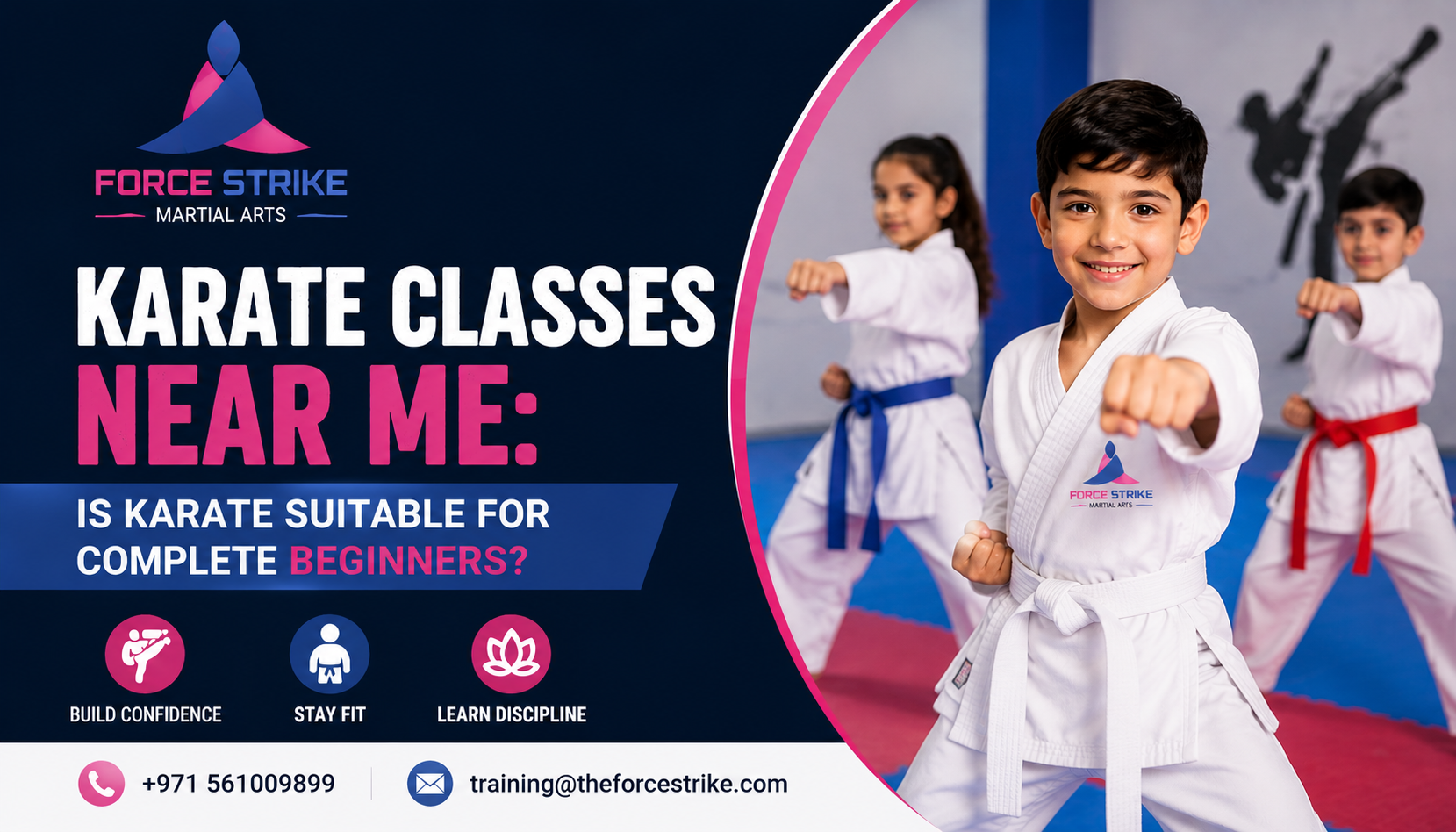
A lot of the people typing "karate classes near me" into a search bar aren't looking for martial arts specifically — they're looking for something that doesn't feel like the gym. Treadmills and dumbbells get old fast for a lot of people, especially kids, and plenty of adults too, if we're honest about it.
Karate sidesteps that in a way pure strength training rarely manages. There's a belt system, so progress is visible instead of abstract. There's a class, so training happens alongside other people rather than alone with headphones in. And the physical demands — striking, footwork, conditioning drills — end up building strength, balance, and cardiovascular fitness without it ever really feeling like "exercise" in the dreaded sense.
For kids, there's usually more going on than fitness anyway. Structure, respect, learning to sit still and actually listen, some self-control — these come up almost as often as the physical side when parents talk about why they enrolled a child in the first place. Training should always match the child's age, though, and sparring or contact drills need proper supervision from qualified instructors rather than just good intentions.
People love to blame themselves for quitting — "I just don't have the discipline." Usually that's not quite right. More often, the format demanded too much willpower and gave back too little structure in return.
|
Approach |
What tends to happen |
|
Solo gym sessions, no real plan |
Drops off within 2–3 months for most beginners |
|
Workout apps, no one holding you to it |
Attendance gets patchy, progress stalls |
|
Fitness classes with a set schedule and coach |
Noticeably better long-term consistency |
|
Martial arts with belt progression |
People tend to stick around longer, with clear milestones |
None of this means solo training is useless — some people genuinely do better left alone with a plan. But for most beginners juggling a job, a family, and about ninety minutes of free time a day, a class removes the hardest part: deciding what to do. You just show up. Someone else has already done the planning.
A handful of mistakes come up again and again, even with people who are genuinely trying hard. Skipping the warm-up because it feels like wasted time is a big one — it isn't wasted, and it's usually the difference between training well and training injured. So is training flat-out every single day with no rest, which tends to backfire rather than speed anything up.
There's also a quieter mistake that doesn't get talked about as much: comparing week one of your own training to someone else's third year in. It's an easy trap and a fast way to feel discouraged over nothing. Chasing intensity over technique causes similar problems — in both strength training and martial arts, sloppy form done hard is usually how people get hurt, not how they get better. And then there's programme-hopping, jumping from one style of training to another every few weeks looking for the "right" one, which mostly just stops your body from adapting to anything long enough to see results.
None of this needs a perfect fix. Mostly it just needs noticing.
When parents look into fitness classes in Dubai, or karate specifically, the decision usually comes down to a handful of practical things: is it close enough to actually get to regularly, how big are the classes, does the coach seem to know what they're doing, and is it grouped sensibly by age.
Worth asking directly before signing up anywhere: are beginners kept separate from more experienced students, or thrown in together? Is there a trial class so you can actually see how a session runs before committing? Does the schedule fit into your real week, or is it going to become one more thing that quietly gets skipped by week three? And is there an actual path forward — belts, levels, something — or is it the same session on repeat indefinitely?
Answers to these vary a lot between academies, so it's worth just asking rather than assuming.
Pull all of this together and it's actually less complicated than it sounds. Pick something repeatable over something impressive — a realistic schedule beats an aggressive one you'll quit by week three, every time. Look for progress you can actually see, whether that's a strength benchmark going up or a belt level in martial arts, because seeing progress is what keeps people showing up when the novelty wears off. Have someone coaching you, at least at the start, correcting form and pacing the intensity so you're not left guessing whether you're doing it right. And mix things up within that structure rather than repeating one activity forever — strength, conditioning, mobility, and something skill-based like karate tend to add up to more rounded fitness than any single one of them on its own. Above all, set expectations that match reality. Real change takes months of showing up, not a few good days.
For families around Arjan and nearby parts of Dubai, in practice this often means looking at local fitness classes or martial arts academies that actually offer a trial session, rather than committing to a year-long plan based on a website alone.
This is roughly the model Forcestrike Martial Arts runs on — structured karate and martial arts classes for beginners and more experienced students, grouped by age and skill level rather than lumped together. It won't fix a bad training plan on its own, but it's built around the same idea running through everything above: consistency and visible progress matter more than any single hard session ever will.
If the goal is actually training strength & fitness in a way that sticks — not another routine that quietly fades out by week four — a structured, coached environment tends to be what makes the difference, whether that's for you or for your kids.
If you're around Arjan or elsewhere in Dubai and want to see what this kind of structured training actually looks like day to day, get in touch with Forcestrike Martial Arts about trial sessions — it's a reasonable way to find out if a schedule fits your week before committing to anything longer term.
Why do most fitness routines fail within the first few months?
Mostly because they were built around motivation instead of structure. Once the initial drive fades — and it always does eventually — unstructured plans tend to fall apart fast, while scheduled classes with a coach behind them tend to hold their shape a lot longer.
Is karate actually a good way to train strength and fitness, or is it more of a hobby?
It's both, honestly. Karate builds strength, conditioning, and coordination while also demanding real discipline, so for a lot of beginners it's easier to stick with than an unstructured gym routine, simply because it doesn't feel like "just exercise."
What should I actually look for when picking fitness classes in Dubai?
Age-appropriate grouping, a coach who'll actually correct your form rather than just count reps, a schedule you can realistically keep, and ideally a trial class before you commit any money.
How many sessions a week should a beginner aim for?
That depends a bit on the person and the programme, but generally a few consistent sessions each week beats occasional bursts of intense training followed by long gaps.
Is martial arts training safe for kids?
It can be, provided it's age-appropriate and properly supervised by qualified coaches — particularly once sparring or contact drills come into the picture, which should always be introduced gradually and never rushed.
How do I know if a karate class near me is right for someone starting from zero?
Look for a programme that keeps beginners separate from more experienced students, offers some kind of trial session, and has coaches who spend real time on fundamentals before pushing into anything advanced.
What's the single biggest mistake beginners make?
Probably chasing intensity over consistency. A tough programme that gets abandoned in week three does far less for you than a moderate one you actually stick with for months.