

Saturday afternoon. Your kid has been on a screen since breakfast. You've told them to go outside twice. They didn't. So now you're the one Googling — taekwondo near me, martial arts for kids, karate classes near me — not entirely sure what you're looking for, just something that gets them off the couch and builds something in them at the same time.
Or maybe it's you. You've been meaning to try martial arts for years. You keep talking yourself out of it. Too old, too unfit, too late. You're not, but we'll get to that.
Either way — here's the honest version of what taekwondo actually is, what it does, and whether it's worth your time in Dubai.
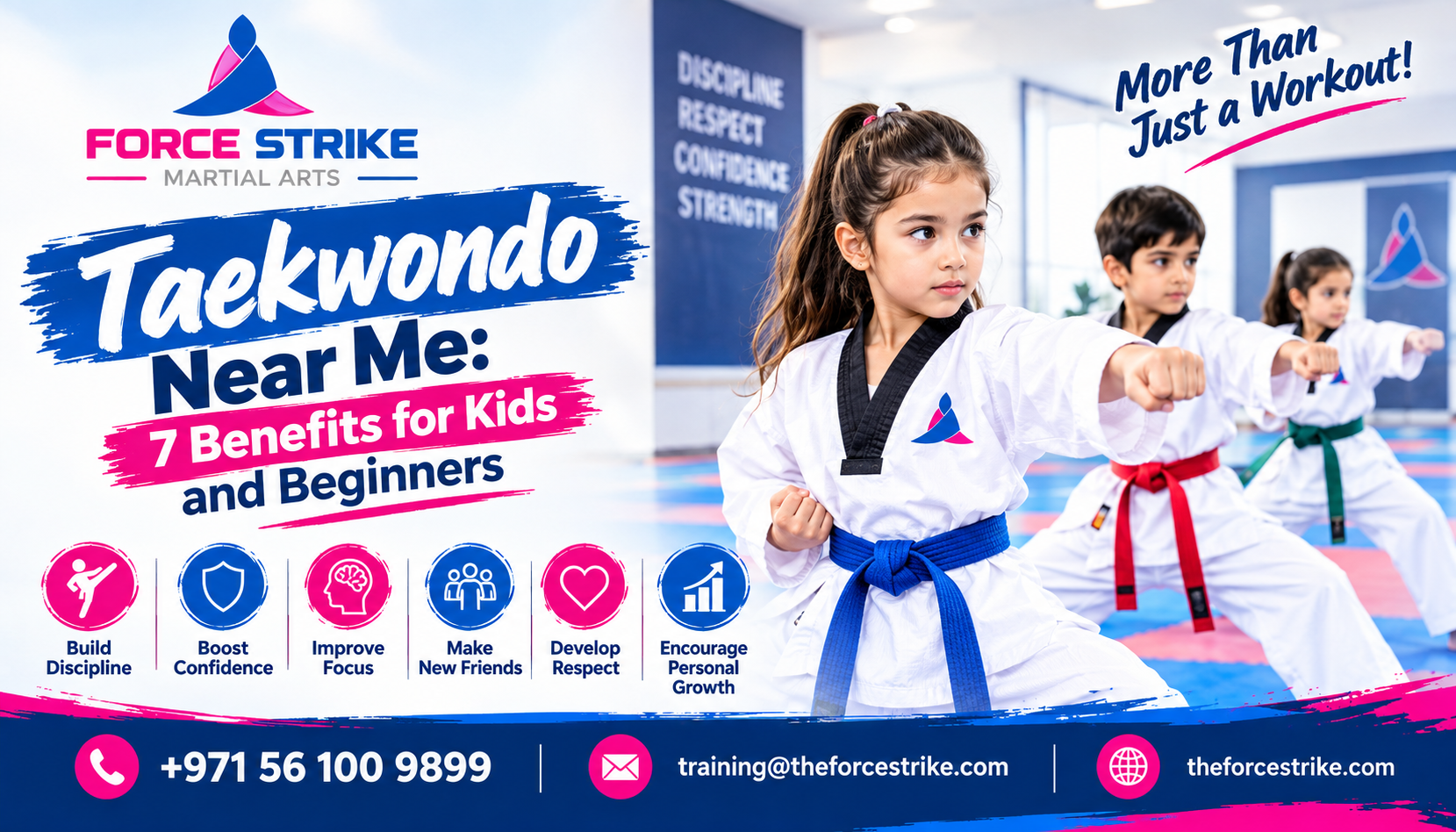
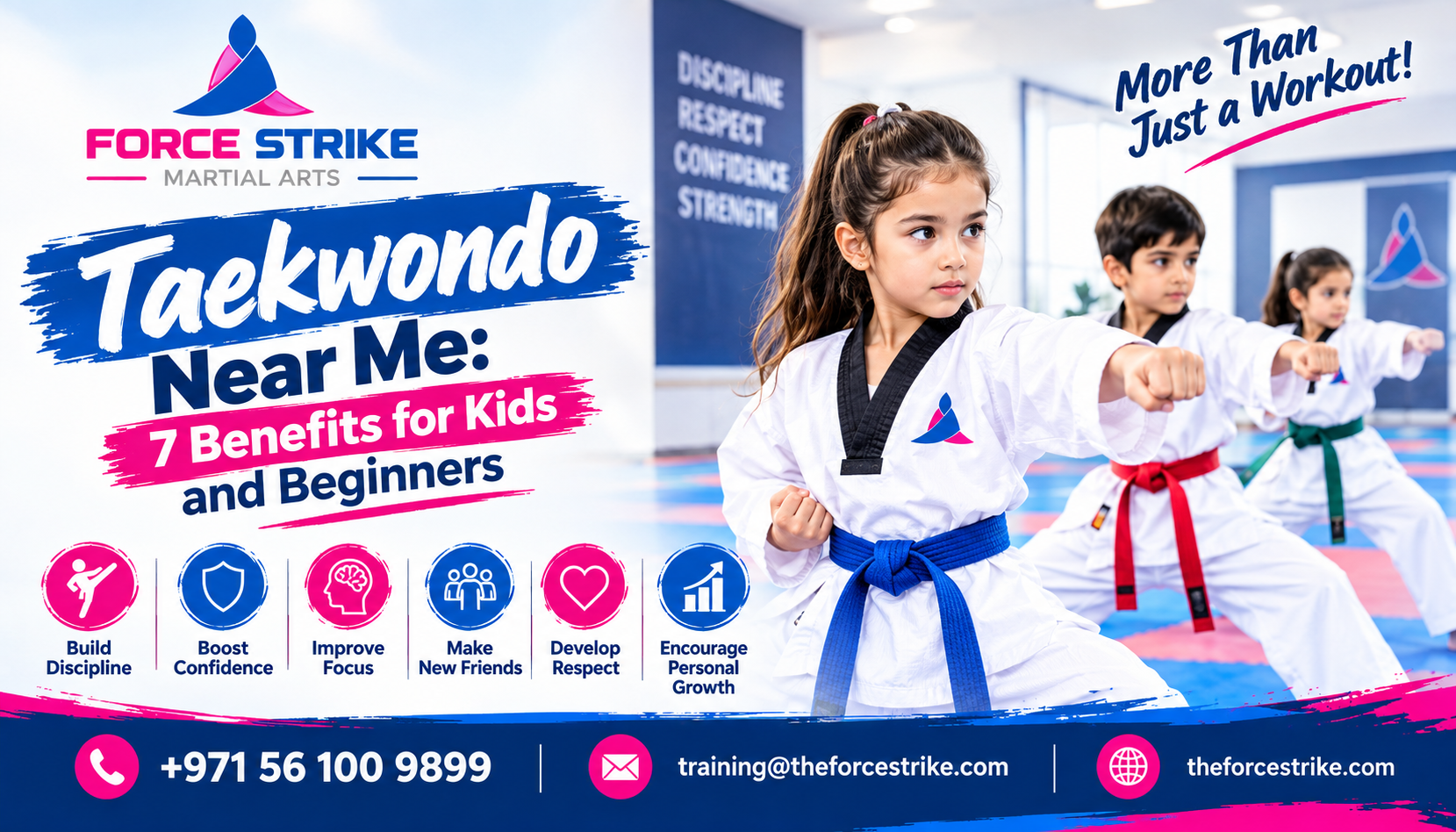
Korean martial arts. Olympics since 2000. Famous for kicks — fast ones, high ones, spinning ones that look borderline impossible until you've trained them for a year and realize they're just technique, not magic.
Two things happen inside a taekwondo near me and most websites blur them together. There's the traditional path — poomsae patterns, self-defense principles, the belt-to-black-belt journey, character development baked into the structure. And there's the sport path — point sparring, tournaments, competitive circuits. Good schools run both. Students gravitate toward whichever fits them.
In Dubai the infrastructure behind it is real. UAE Taekwondo Federation. Organized competitive circuits. Academies like Forcestrike Martial Arts with credentialed coaches and actual competitive backgrounds. This isn't someone with a weekend certificate teaching in a rented room.
Parents sign up expecting better fitness. What they don't expect is the grading day phone call — "he was so calm, I've never seen him like that before."
Gradings put children in front of judges. They perform. They get assessed. They pass or they don't. Do that six times across a year and something shifts in how a child handles stressful situations outside the dojang. School presentations. Exams. Social friction. The composure builds quietly and then parents suddenly notice it.
Not every child. Not overnight. But consistently enough that coaches across Dubai mention it without prompting.
Both great sports. Neither one seriously develops single-leg balance, rotational hip mechanics, or the spatial awareness that taekwondo demands from the first class.
A kid who trains for twelve months moves differently. Falls better. Recovers faster. Has a body awareness that most children their age simply haven't developed. That compounds over years in ways that go well beyond the sport itself.
Taekwondo does not make a seven-year-old invincible. Any instructor who implies that is misleading you.
What it does: teaches distance management, how to read a threatening situation, how to respond physically if there's no other option. The footwork and striking mechanics transfer. The composure under pressure — built through sparring and grading — transfers. That's genuinely useful, and it's more than most children get from any other extracurricular.
For adults the application is even more direct. Footwork, head movement, striking from distance. Practical in ways that more stylized arts sometimes aren't.
People mock colored belts. Fair enough. But the system solves a real problem: it makes personal progress visible and earned.
Earning a yellow belt means something concrete happened. Standards were met. An instructor assessed the student and passed them. That's different from a participation trophy in a fundamental way — and children understand the difference even when they don't articulate it.
The belts also give the whole journey a shape. Without them, "get better at taekwondo" is a vague instruction with no landmarks. With them, there's a map.
The link between martial arts training and improved concentration in children shows up repeatedly across different studies in different countries. The training format is why: clear instruction, immediate physical execution, repetitive drilling that demands real attention rather than passive watching.
Kids who find conventional classroom focus difficult often do surprisingly well in taekwondo. The movement is structured, expectations are clear, feedback is instant. Parents near Forcestrike Martial Arts's Dubai location report this regularly — improved homework habits, better classroom behavior — usually around the three to four month mark.
It's not guaranteed. But it's real enough to take it seriously.
Team sports carry a social hierarchy that can be genuinely rough for kids who aren't natural starters. Who plays. Who sits. Who the coach notices. That's visible and continuous and sometimes discouraging in ways that last.
Taekwondo removes most of that structure. Your belt is yours. Your progress doesn't come at someone else's expense. The friendships formed through shared difficulty — grading nerves, hard training days, breakthrough moments — tend to be solid ones.
For children who've been burned by team sport dynamics, this environment is often a revelation.
Muay Thai people will tell you boxing is better. Boxing people will suggest Muay Thai. Everyone seems to think taekwondo is only for children.
It's not. Adult beginners train at serious taekwondo schools in Dubai regularly. Flexibility takes longer to develop. Certain high kicks require more patient work. But the art is completely viable as an adult pursuit, and coaches who've worked with adult learners know how to adapt. Starting at thirty-five is different from starting at eight. It's not worse — just different.
Taekwondo: primarily a kicking art. High-line kicks, speed, Olympic competitive pathway. Karate Classes Near Me: more even distribution between hands and feet, some styles emphasizing close range, broader technical vocabulary in certain traditions. Both build discipline. Both have strong children's programs. Both produce capable students when the coaching is good. The style on the door matters less than the human standing in front of the class — visit both, watch the coaching, decide from there.
Children from about five years old. That's the sweet spot — nervous system adaptability is high, foundational habits form quickly, and the structured environment suits that developmental stage. Quality schools separate age groups properly. A five-year-old isn't training alongside competitive teenagers.
Teenagers who want individual achievement over team placement. Adults who want skill development, not just fitness. Families who want to train together — more common than people expect, and the shared experience does something for the relationship that's hard to manufacture any other way.
Dubai residents specifically tend to stay with it longer than people elsewhere, partly because the school year maps neatly onto grading cycles, and partly because the UAE competitive circuit gives motivated students somewhere real to go.
Quitting before week six. The first month of taekwondo training is the most unrewarding period of the entire journey. Coordination hasn't clicked. Kicks feel wrong. Nothing looks like the promotional video. Most people who leave, leave here — right before the shift happens. Give it eight weeks minimum before forming any opinion.
Training only before gradings. Students who coast between tests and cram before them hit a ceiling eventually. The belt stops representing real ability. Train for training, not for the certificate.
Rushing sparring. Some beginners push for contact work early because it feels more legitimate. Good coaches push back. Sparring without a technical foundation just reinforces bad mechanics at speed. The boring fundamentals come first for a reason.
Watching other students' timelines. The person who earns their next belt three months before you isn't ahead of you on any meaningful axis. Different bodies, different histories, different starting points. The comparison is genuinely useless and coaches say this constantly because students need to hear it constantly.
The UAE's investment in combat sports infrastructure over the last five years has been real and visible. The competitive pathway for taekwondo specifically is more organized — junior circuits, adult categories, regional tournaments with proper structure. Students at serious academies like Forcestrike Martial Arts have genuine places to compete if they want to.
The beginner intake process at better schools has also matured. Dedicated new student programs rather than just absorbing people into open classes. Age-specific curriculum rather than one format for everyone. This is the standard at well-run facilities now, not a selling point.
Taekwondo Dubai offers something genuinely rare in the fitness world — a long-term individual development path that works on the physical, mental, and social dimensions of a person simultaneously. Most activities do one of those things. Team sports do two. Taekwondo, trained consistently in a good school, does all three in a way that compounds over years.
Families who try it tend to stay longer than they planned. That's not an accident.
If you're in Dubai and ready to find out for yourself, Forcestrike Martial Arts is where to start. Structured programs for children and adult beginners. Coaches with real competitive backgrounds. A proper beginner pathway — not just open classes and a hope you figure it out. The first session shows you more than any website can.
Stop researching and book a class. One session at Forcestrike Martial Arts tells you what weeks of reading doesn't. Taekwondo Dubai has a real home here — properly coached, properly structured, and genuinely invested in what happens to students after they walk through the door.
What age can kids start taekwondo?
Around five. At that age classes focus on movement and listening — no pressure, no complex technique. Starting between five and seven builds habits during the years when physical learning is fastest.
How long to get a black belt?
Four to six years training two to three times a week. For adults it's similar, depending on consistency. Black belt isn't the finish line — most coaches describe it as where real learning begins.
Is taekwondo actually useful for self-defense?
Yes, within scope. Distance management, striking mechanics, composure under pressure — those transfers. It doesn't cover ground fighting. Cross-train with jiu-jitsu if that's a priority. As a standalone striking foundation, it's among the most practical options available.
Taekwondo or karate for my child?
Visit both. Watch how each coach handles a kid who makes a mistake. That tells you more than any style comparison. Taekwondo leans heavily on kicking and has an Olympic pathway. Karate covers a broader technical range. Coaching quality matters far more than the name on the door.
How often should a beginner train?
Twice a week minimum. Three times is where progress actually accelerates. Once a week keeps you connected but doesn't give the nervous system enough repetition to build technique properly.
What happens in the first class?
Warm-up, basic stretching, fundamental stance and movement drills. No sparring, no contact with anyone. Coaches have done this hundreds of times — the first class is designed to be accessible. Wear comfortable athletic clothes. The uniform comes once you're enrolled.