.png)


.png)
Parents usually go looking for karate classes near me with a short list of hopes. Discipline, mostly. Some confidence. A way to burn off energy that doesn't involve a screen.
Those are fair reasons, and good programmes can deliver on them. But the lessons that stick with children are often quieter ones that never appear on an academy's website. How to be bad at something and keep turning up. How to hold back when you're angry. How not to collapse when hearing "that's not quite right".
It examines what kids can learn in karate, beyond kicks, and why it is important for families in Arjan and Dubai, and how to find out if a local academy will be able to teach any of it.
Physical technique is taught, such as stance, strike, block and kata (set movement sequences). They also acquire good practices from the way in which training is delivered: listening to training, training patiently, respecting others and controlling frustration. The visible part is with technique. Most often it is the habits that parents observe outside the dojo, although the amount of benefit a child receives is related to the coaching and to how regular he/she is.
Most children are used to being fine at the things they do. Then they join a karate class and a stance that looks simple turns out to be hard. The kata an older student performs looks impossible. Everyone seems to know where to put their feet.
That's uncomfortable, and it's useful. A white belt spends weeks being visibly unskilled in a room where that's completely normal, because everyone there started the same way. Children learn that being a beginner isn't a verdict on them. It's a stage.
That carries over. A child who has stayed clumsy at something for a month and then slowly improved is better prepared for a new school subject, a new instrument or a new friendship group than one who has only done things they were already good at.
People expect a martial art to teach children how to hit. Well-run Karate Classes in Dubai spend a surprising amount of time on the opposite.
Control is built into the training. Strikes in partner drills stop short of contact. Etiquette rules how students are greeted, and how they start and finish. A coach's concern for a child's self-control is as great as his care for the sharpness of his punch.
This can be important for a temper tantrum-prone child. The training provides them with a physical outlet as well as directions and guidelines as to when and how to use it. Another important concept of Karate is that 'the best conflict is the one that never becomes a physical fight'. It doesn't always have an immediate impact on them, but when they hear this consistently from a trusted adult, it can make a difference.
In many classrooms, correction can feel like criticism. In karate it's simply how anyone improves. The coach says your back foot is turned out, you fix it, they say "good," and you move on. No drama.
Children develop a sense of the rhythm: listen, move, listen, move, listen, move. They cease to take "that's not quite right" as a personal criticism. For some parents, it is first detected at home: when the child doesn't respond to the same type of feedback when it comes to homework or tidying up.
The manner in which the coach provides feedback is a very important factor. Specific, calm feedback builds this skill. Public embarrassment or constant vague pressure does the opposite, which is one reason the coach matters more than the discipline's name.
Children are asked to balance on one foot, turn through the hips, maintain a straight back and breathe and coordinate arms and legs simultaneously in Karate. That's new information for a kid that spends most of their time at a desk or on a sofa.
Many kids develop an awareness of posture, balance and body motion over time. They also practice a skill that is extremely useful on any playground – falling safely and rising up. This is referred to as physical literacy at times. A lower kick that isn't as showy as another kick, but makes other sports and activities easier later.
Many academies have children trained for a couple of months who then help newer children to a position and/or drill/lead a part of the warm up. Suddenly, a small person looks up at a nine year old.
It's a light way to learn about taking responsibility and being patient. Explanations of something that you have recently learned are also one of the best ways to fully grasp it, and a school day with everyone at the same level and age is only rarely available.
During the summer months it is difficult to enjoy the outdoors in Dubai. The weather does not affect the routine, as Karate is kept indoors with air-conditioning and follows a regular schedule. This is because the lessons above are built up slowly through repetition.
A large number of families are also separated from grandparents and other extended family members. Several coaches and training partners viewed repeatedly throughout the week can form a stable group that may be more difficult to find elsewhere that can become a part of a child's social circle.
Families looking for karate classes in Arjan Dubai, often have to navigate school runs, work and traffic. The chances of your child attending regularly are much higher if there is an academy within a manageable drive. It is regular attendance that brings about change.
A lot of things here are not guaranteed, and it is different for each child. Parents watch three areas.
At school. Some children adjust more readily to tasks, or are more successful using teacher feedback. There are many other factors that influence student behaviour within the school, but the focus karate asks for can help.
At home. If a child has learned to take a time out before responding to arguments, they might find it easier to defuse the situation with siblings.
Among friends. Having a more upright posture, high voice and physical strength can alter a child's approach to social interactions. While Karate will not cure bullying and good academies will not guarantee that, self-assurance can enable children to handle conflict in a calmer manner.
|
Karate |
Taekwondo |
Kickboxing |
Team sports |
|
|
Main emphasis |
Technique, kata, control |
Kicking, speed, poomsae |
Striking and conditioning |
Teamwork, game play |
|
Formal belt progression |
Yes |
Yes |
Varies |
No |
|
Individual feedback |
High in small classes |
High in small classes |
Varies |
Varies by coach |
|
Contact at junior level |
Controlled |
Controlled |
Often higher |
Varies |
|
Indoor, year-round in Dubai |
Yes |
Yes |
Yes |
Often outdoors |
The academy and coach matter more than the label. A well-run taekwondo or kickboxing class can serve a child better than a mediocre karate one.
Search results for karate places near me tend to look alike. The difference becomes apparent during a regular class, not a demo class.
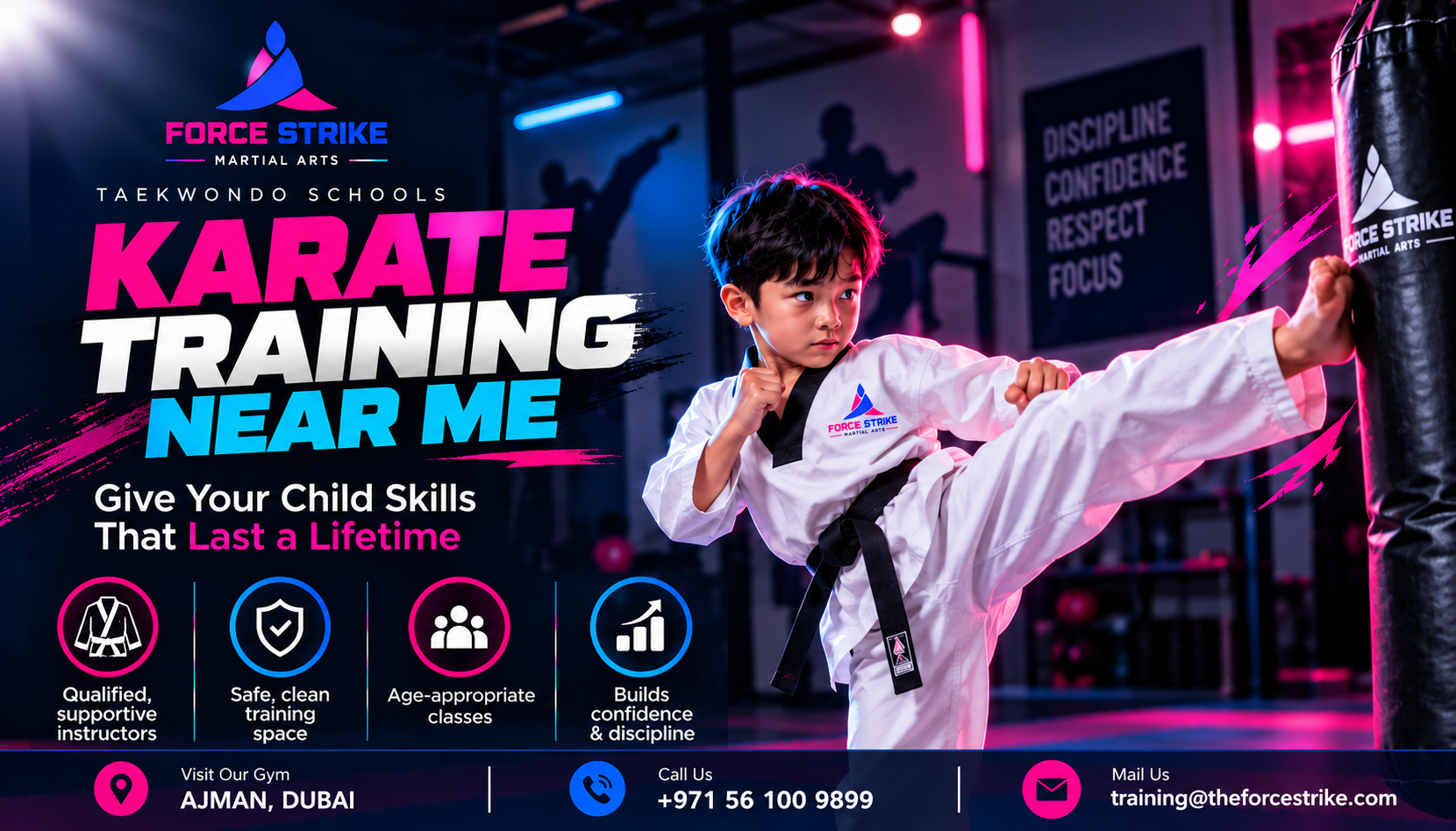
The fee level is different from academy to academy – do not take it at face value as just the monthly amount. That means uniform, grading fees and any registration costs. Forcestrike Martial Arts is one local option in Arjan. As with any academy, the best step is to visit, watch a class and ask these questions in person.
Beyond fitness, families are seeking information and outcomes, including focus, emotional regulation, and screen-free routines. Many academies also have inclusive classes for girls and better ways of indicating to parents what the child is learning. These are questions to ask with them when you visit, rather than assumptions about any academy.
The choice of karate between kicks and punches will seem like a no-brainer in class near me. The long term benefits are subtler for many children: comfortable as a beginner, holding back when necessary, accepting criticism gracefully and getting moving with confidence. Visit is a more important part of those lessons than comparing websites because the coach and environment are key components.
If you are interested in learning karate in Arjan or the local area, go to Forcestrike Martial Arts and observe a kids class and see what is available for a first class. By observing the way that the coaches work with kids, you'll learn more than a listing.
What age can children start karate in Dubai?
Many academies accept children from around four or five, often with introductory classes first. Formal belt training usually starts a little later. Policies vary, so check with each academy.
Is karate safe for children?
Properly supervised, age-appropriate karate is generally considered a manageable-risk activity, but no physical activity is risk-free. Ask how contact is introduced and supervised.
How long before my child shows progress?
Fitness and coordination can improve within weeks. Changes in focus and confidence tend to take a few months, and they vary from child to child.
What should my child wear to a first class?
Comfortable athletic clothing is usually fine. Many academies lend or advise on uniforms, so ask before buying one.
How often should my child train?
Two sessions a week is a common starting point. More can help if your child enjoys it and the schedule allows.
.png)
.png)
.png)