

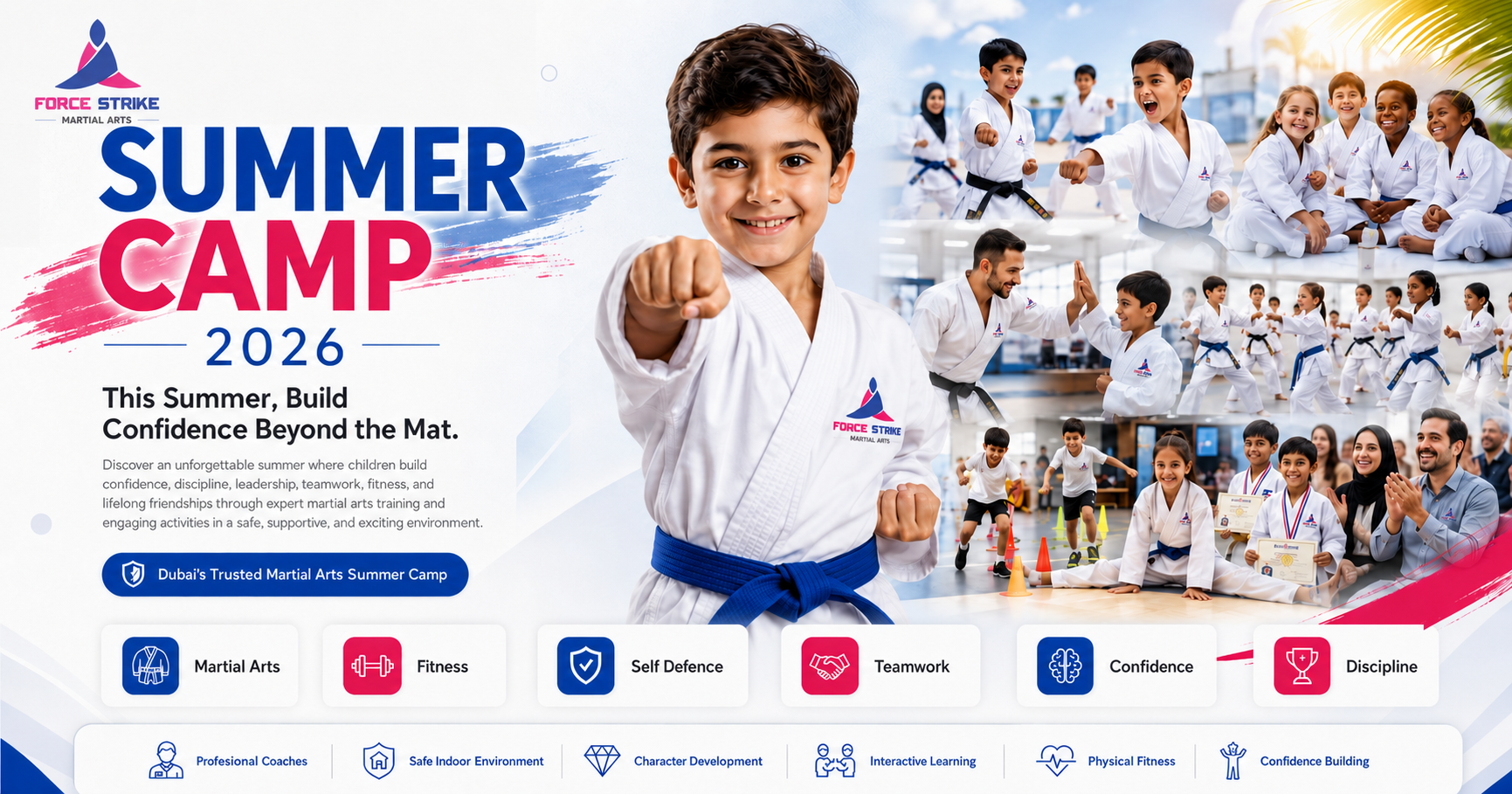
Summer in Dubai creates a specific problem for families. Schools close for two to three months. The heat makes outdoor activity difficult for most of the day. Children who've been in structured routines since September suddenly have weeks on their hands — and parents who are still working trying to figure out what to do with that.
Summer Camp 2026 is the answer a lot of Dubai families are landing on. Not because camps are new. Because the better ones have changed — moving away from generic activity programmes toward structured skill-building that produces outcomes parents can actually see. A child who spends six weeks learning karate, kickboxing, or Jiu-Jitsu in a well-run environment doesn't just come back entertained. They come back different. That's a distinction worth understanding before you book anything.
Direct Answer: Summer camps in Dubai in 2026 are structured holiday programmes running during the school break, combining physical training, skill development, and creative activities in a supervised environment. The best ones — particularly those built around martial arts, fitness, and arts — produce developmental outcomes alongside the entertainment value.
The distinction between a childcare solution and a genuine developmental programme is worth making clearly, because both exist in Dubai's summer camp market and they look similar on the surface. What separates them is the quality of instruction, the structure of daily programming, and whether children are actively building something — or just being kept busy somewhere safe. Those are different things, and parents who've been through both tend to know the difference by week three.
The summer holiday here runs longer than most school calendars globally — late June through early September in most cases. For working parents in a city where the pace is demanding and domestic arrangements don't usually cover structured child supervision during school hours, that's a significant gap. But the logistics argument isn't actually the most interesting one.
Dubai's residential structure means many children spend their school year in relatively controlled, peer-specific social environments. Summer camps — particularly those that mix age groups and skill levels in a structured training setting — expose children to a different kind of social challenge. They have to earn respect somewhere new, navigate unfamiliar peer dynamics, and develop independence from their usual social scaffolding. That's genuinely valuable, and it doesn't happen at home.
For expat families specifically, there's an added dimension. Children who've spent a summer building real physical confidence through martial arts training at a facility like Forcestrike Martial Arts in Arjan tend to arrive at the next school year with a different foundation — not just fitter, but more settled in themselves. Parents notice it. So do teachers.
Martial arts is where the developmental outcomes concentrate, and a camp that covers multiple disciplines rather than just one gives children exposure to genuinely different kinds of challenges.
Karate builds discipline through form and precision — every technique has a specific correct method, and reaching it requires patience and repetition. That relationship with effort is one of the things that transfers most clearly outside the dojo. Children who spend a summer learning karate develop tolerance for the slow process of getting something right, which shows up in how they approach difficulty generally.
Kickboxing is physically demanding in a way that builds real cardiovascular fitness alongside striking skills. For children with energy to burn, the combination of movement and technique holds attention far better than static training. Sessions are intense enough to tire children out properly — which parents of high-energy kids tend to appreciate by the second week.
Jiu-Jitsu develops problem-solving under pressure. Grappling requires thinking, adapting, and staying composed when a position isn't going your way. It's the discipline that produces the most visible changes in emotional regulation — children who train BJJ learn to manage frustration in real time, every session, which is harder to teach in almost any other format.
A camp that runs all three gives children a summer of genuinely varied challenges. Different physical demands, different mental requirements, different kinds of success and difficulty. That variety is part of what makes multi-discipline martial arts camps produce broader developmental outcomes than single-sport alternatives.
The art and craft sessions serve a different function. Creative activities in a camp context aren't about producing skilled artists — they're about sustained focus on something that has no single correct answer, and the tolerance for ambiguity that comes from working through a creative problem. Children who alternate between high-intensity martial arts sessions and quieter creative work across the same day develop a wider emotional and cognitive range than those in single-format programmes. The contrast between the two types of engagement is part of what makes it work.
Fitness and conditioning rounds out the programme. Building strength, endurance, coordination, and agility through structured sessions improves performance across all the other activities and builds physical habits that outlast the camp itself.
The changes parents notice after a well-run martial arts summer camp tend to fall into predictable patterns — which is itself telling. When the same outcomes show up independently across different families and different children, they're programme-driven rather than coincidental.
Confidence comes up first, almost every time. Not the loud kind — the quiet, grounded sort that comes from being physically challenged and coming through it. Children who've spent a summer training in martial arts arrive at the next school year carrying themselves differently. Teachers notice before parents have said anything. Other parents notice at school pickup.
Focus is the other consistent one. The sustained attention required to learn striking technique or grappling sequences — drilling something repeatedly until it stops feeling foreign — builds concentration in a way that most other childhood activities don't demand. Several Dubai schools have independently noted improvements in classroom focus and self-regulation among children who train martial arts regularly. It's not a coincidence.
Social development in a summer camp setting also works differently from school. The shared physical challenge of martial arts training creates a particular kind of bond — being in it together, helping each other through difficult sessions, the unspoken respect that develops between training partners. Connections that take months to build at school can form in two weeks on the mat.
|
Option |
Developmental Value |
Physical Activity |
Social Engagement |
Skill Building |
|
Martial Arts Summer Camp |
Very High |
Very High |
High |
Very High |
|
Sports Camp (single sport) |
High |
Very High |
Medium |
High |
|
Academic/Tutoring Programme |
Medium |
Low |
Low |
Medium |
|
Creative Arts Camp |
High |
Low |
Medium |
High |
|
General Activity Camp |
Medium |
Medium |
High |
Low |
|
Home-based / Screen time |
Low |
Low |
Low |
Low |
A martial arts summer camp that also incorporates art, fitness, and creative activities sits at the top for overall developmental value — and by a reasonable margin. Single-sport camps develop physical skills well but miss the cross-discipline breadth that martial arts programmes deliver. Academic programmes have their place but don't touch the physical and social dimensions at all. The home/screen option is there for comparison's sake; the numbers speak for themselves.
Quality variation is the main issue, and it's harder to spot than it should be. The term "summer camp" covers a huge range of actual experiences — from genuinely well-structured developmental programmes to essentially supervised entertainment with activities attached. Marketing materials rarely make this distinction clear, which is why visiting before enrolling matters so much.
Age mixing is another one that gets overlooked. Some camps group children too broadly — putting 5-year-olds and 10-year-olds in the same martial arts class. Neither group benefits from that arrangement. A 5-year-old needs different instruction, different pacing, different expectations than a 10-year-old who's been training for two years. When you see a wide age range in the same class, it usually means the programme hasn't been designed with real pedagogical intent behind it.
Continuity of instruction is something parents rarely think to ask about. Summer camp instructors are sometimes different from a facility's regular coaching team — seasonal hires brought in specifically for the holiday period, without deep knowledge of the curriculum or experience with the specific children enrolled. At Forcestrike Martial Arts in Arjan, the same coaching team that runs year-round programmes delivers the summer camp, which matters for both quality and the safety of children new to the environment.
Convenience shouldn't be the deciding factor, even though it often is. Location matters for logistics — a camp twenty minutes away gets attended more consistently than one on the other side of the city — but a programme that's close and poorly run isn't actually serving your child. The extra drive for the right place pays back in what a child comes home with.
Not visiting before signing up. Most reputable summer camps in Dubai actively welcome parent visits or observation sessions. A real view of the facility, the coaches, and how a typical session runs tells you things no website or brochure can. If a camp resists this, that's useful information too.
Full-duration enrollment before trying a shorter block is another one. Many camps offer week-long entry before any longer commitment. Starting there is sensible — it gives a child time to settle in and gives parents a realistic picture of the experience before committing to a full summer.
The adaptation period catches parents off guard more than anything else. The first few days of a new structured environment are often rough — unfamiliar routine, unfamiliar faces, unfamiliar expectations. Parents who pull children after a difficult day two or three almost always do so right before things settle. The turn usually comes around day four or five, once the routine establishes itself and children stop being overwhelmed by everything being new at once.
Book early. This is the advice that sounds obvious but gets ignored consistently. The best martial arts in Arjan Dubai — the ones with structured programmes, limited class sizes, and experienced coaching teams — fill up well before the summer break begins. Leaving the decision to May or June limits options significantly, and the best spots at the best facilities go first.
Match the programme to the child rather than just the location. A child who's been training karate for two years benefits from a different programme than a complete beginner. A child who finds competitive partner work stressful might do better in a programme that emphasises individual progression. Worth having that conversation with the coaching team before enrolling rather than assuming one format works for all children.
Look for camps that build on themselves week by week. The programmes worth choosing are designed so that children leave each week with something concrete they didn't have at the start — a new technique, a grading, a demonstrated skill, an understanding that wasn't there before. That progressive structure is what separates a developmental programme from organised activity supervision. Ask specifically what a child will have learned by the end of the first week, the second, the fourth. If the answer is vague, the programme probably is too.
Demand for structured martial arts summer camps is growing faster than general activity camps in Dubai. It tracks with the broader youth martial arts trend — parents are choosing skill-based programmes over generic alternatives because the developmental outcomes are more visible and more lasting. A child who completes a summer of karate training has something concrete to show for it.
Multi-discipline camps are outperforming single-format programmes on both retention and parent satisfaction. The variety keeps children engaged across longer durations in a way that doing the same activity for six weeks doesn't. Kickboxing on Monday, Jiu-Jitsu on Wednesday, art on Friday — the alternation between different types of challenge is part of what makes the summer feel full rather than repetitive.
Half-day formats are growing too, particularly for younger children or those new to structured camp settings. The shorter format is a gentler introduction that still delivers skill development — and for some parents the drop-off flexibility is genuinely useful.
Girls' martial arts programming has expanded noticeably. Several Dubai facilities now run summer camp tracks specifically designed to be welcoming for girls across all age groups. The demand has been there for a while — the supply is finally catching up.
Summer Camp 2026 in Dubai isn't just about keeping children occupied during the break. The right programme — martial arts disciplines like karate, kickboxing, and Jiu-Jitsu combined with creative and fitness activities — produces outcomes that show up at the start of the next school year and keep compounding after that.
The city has solid options. Finding the right one takes a visit, a conversation with the coaching team, and a bit of honest thinking about what your specific child actually needs from a summer. That's a morning of effort. What it produces is worth considerably more than that.
If you're looking at Summer Camp 2026 options in Dubai — whether in Arjan, Al Barsha, Dubailand, or nearby communities — visit Forcestrike Martial Arts to see the programme structure, meet the coaching team, and book a place before availability closes. Early enrolment secures both the spot and the best rate.
When do summer camps in Dubai typically run in 2026?
Late June through August, aligned with the school holiday calendar. Some facilities run rolling weekly enrolment; others use fixed blocks. Check early — the structure varies considerably between camps.
What age groups do martial arts summer camps accept?
Most take children from age 4 or 5 upward, with separate tracks by age group. Well-run camps separate these meaningfully — a 5-year-old and a 10-year-old shouldn't be in the same martial arts session.
What disciplines are covered?
At comprehensive programmes like Forcestrike Martial Arts, children train across karate, kickboxing, and Jiu-Jitsu alongside fitness conditioning and art and craft sessions.
How much does summer camp cost in Dubai?
Weekly rates typically run AED 500 to AED 1,200. Full-summer packages offer better value per week and tend to sell out first.
Is a summer camp suitable for children with no martial arts experience?
Yes. Beginner tracks are standard at reputable programmes. Most children enrolled have no prior experience — it's the norm, not the exception.
How do I know if a summer camp is well-run?
Visit before enrolling. Ask what a child will have learned by the end of week one and week four. A camp with clear, specific answers to that question is worth considering. One with vague responses probably isn't.