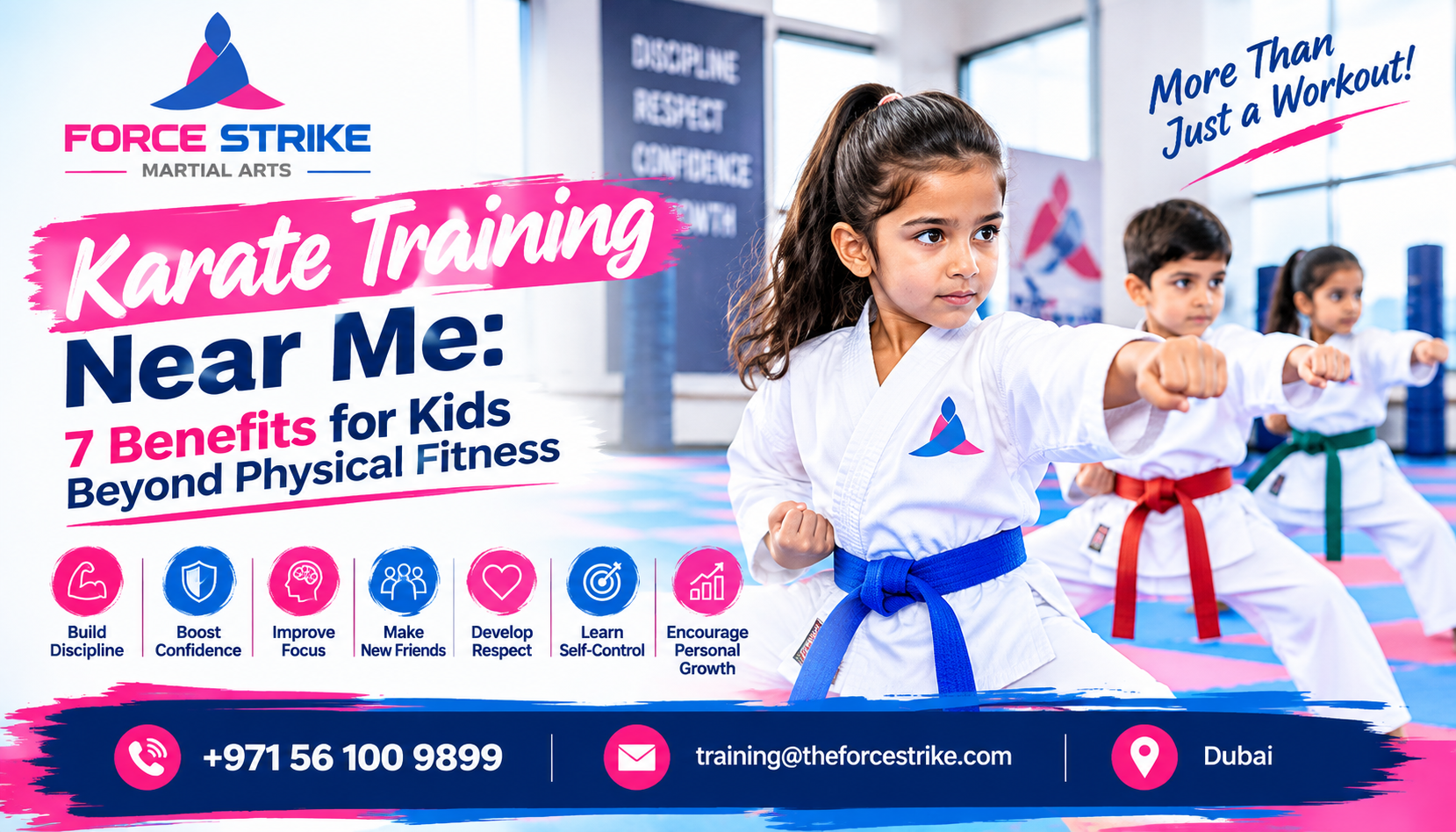


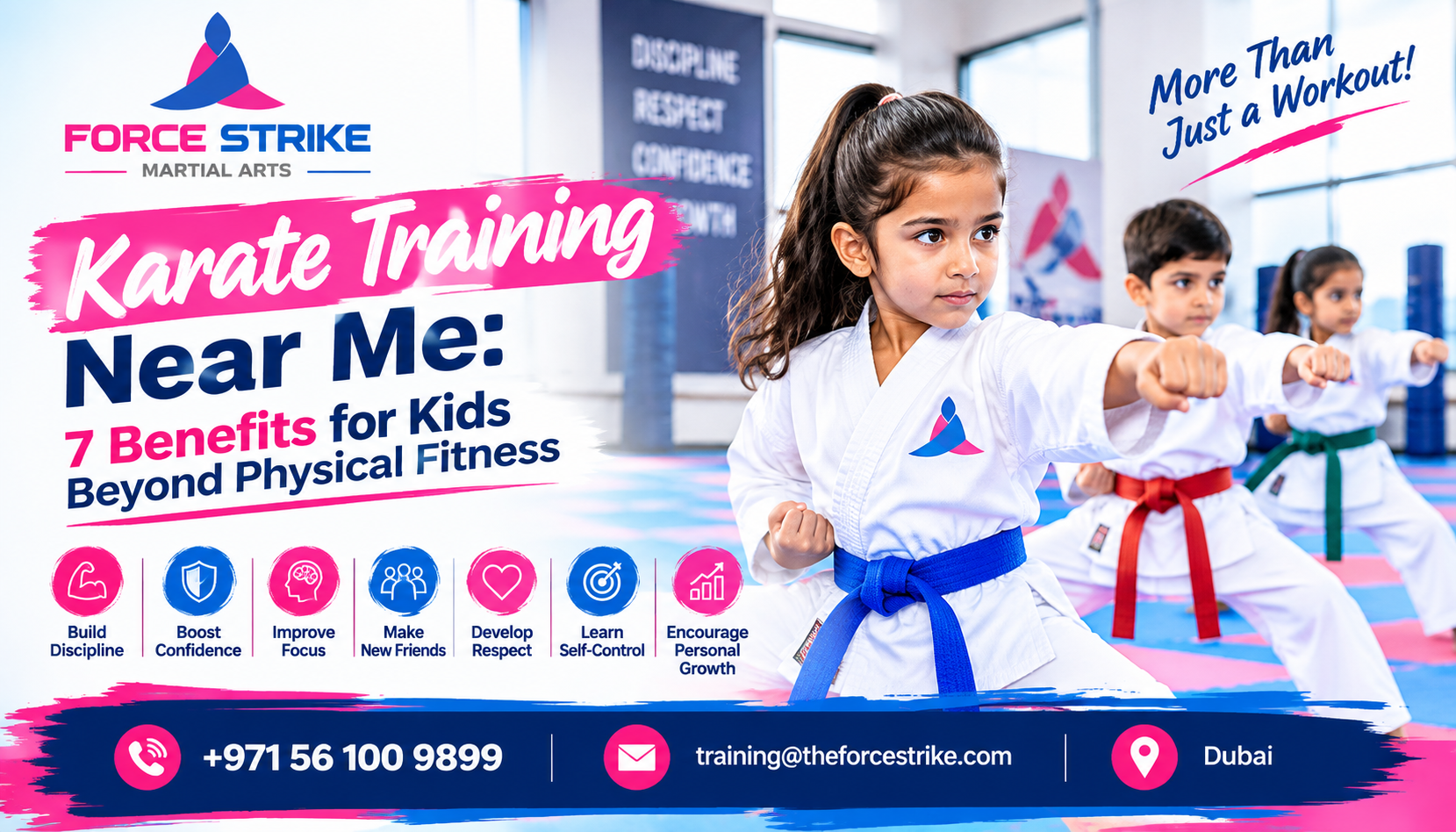
Parents usually type "karate training near me" into Google for one reason — they want their kid to stop bouncing off the walls and maybe learn to throw a punch properly. I get it, that's the obvious pitch. But after years of watching kids come through the door fidgety and leave calmer, I've stopped thinking of the fitness angle as the point. It's more like the hook that gets families in the door. What actually changes a kid happens somewhere else entirely — in how they handle being told "no," how long they can sit with a hard task before quitting, whether they can look an adult in the eye when they've messed up.
So if you're in Dubai comparing karate classes near me against swimming lessons or another football academy, let me walk you through what actually happens once the trial period ends and the routine sets in. Whether you're searching broadly for karate classes in Dubai or narrowing it down to karate classes in Arjan Dubai because that's where you live, the underlying question is the same: what does this actually do for my kid?
Short version: discipline, focus, a working handle on their own emotions, and the ability to lose without falling apart. The kicking and blocking is real, and yes, they get fitter — but that's not why parents keep re-enrolling their kids year after year. It's the other stuff. A decent instructor treats the physical training as the delivery mechanism, not the destination.
Nobody tells you this part, but the belt system is basically a patience machine wearing a Karate Place Near Me uniform. Try explaining to a six-year-old that the yellow belt isn't happening this month, maybe not next month either. That's rough for a kid who's grown up with same-day delivery and skip buttons on everything. It's also, weirdly, one of the more useful things they'll learn all year.
Dubai doesn't make this easier. Between school, tuition centers, screens, and the general pace of things here, a lot of kids never get a stretch of time where they have to sit with boredom or frustration and just work through it. A dojo forces that, over and over, in a setting where the stakes are low enough to actually learn from it.
Discipline that isn't about getting yelled at. It's bowing before you step on the mat. It's standing still because you were told to. It's doing the same kata for the fortieth time because it still isn't clean. Kids pick up structure this way without anyone lecturing them about it — parents in Arjan tell us this is often the first place their child follows a rule with zero reward attached.
Focus that shows up somewhere else entirely. Sparring makes a kid watch shoulders, judge distance, and react, all at the same time, which is a very different kind of attention than anything a screen asks of them. Teachers have mentioned better classroom focus in kids training a couple times a week — though this varies a lot by age and how consistent the training actually is.
Staying composed when things get stressful. This is the one that catches parents off guard. Sparring, grading in front of a crowd, getting hit and having to reset — karate puts kids through small doses of real pressure and asks them to hold it together. That skill doesn't stay on the mat. It turns up during an exam, or the second a sibling says something cruel and the old version of the kid would've screamed.
Confidence that's actually earned. There's a real gap between a kid who's been told they're amazing and a kid who knows, concretely, that they can defend themselves and work for the belt around their waist. The second kind holds up better under pressure. We see this constantly with the quiet ones — the kid who wouldn't make eye contact in month one is leading warm-ups by month four.
Respect, rehearsed until it's automatic. Bowing to the sensei, thanking your sparring partner, helping the newer white belts figure out a stance — none of this is extra. It's baked into every single class. That's a different animal than telling your kid to "be respectful" at dinner and hoping it sticks.
Losing, and getting back up. Every kid who spars eventually gets caught off guard, loses a match, blanks on a kata mid-grading in front of everyone. What matters is what the instructor does with that moment — not shaming the kid, but treating the loss as data, as something to fix. Kids who stick with this long-term end up with a noticeably different relationship to failure than kids raised on participation trophies.
A social circle that doesn't depend on the school year. Dubai families move constantly — in, out, across the city, back to another country entirely. Friend groups shift every September. A dojo gives kids one relationship that doesn't reset every academic year, and for some kids that's the thing that actually keeps them coming back.
Here's the myth: karate classes in Dubai are for aggressive kids who need an outlet, or naturally athletic kids who'll be good at it. In practice it's often the opposite kids who benefit most. Anxious children tend to gain the most from the structure. The hyperactive ones need discipline more than they need another way to burn energy. Quiet kids need confidence-building far more than they need a "physical outlet." If your kid doesn't fit the stereotype of a future black belt, that's honestly not a reason to skip it.
One mother in Arjan brought her seven-year-old to Forcestrike Martial Arts after his teacher flagged him for constantly blurting out answers in class. A few months in, unprompted, his teacher mentioned he'd started raising his hand and waiting to be called on. Nobody taught him that directly — it's just what he'd been practicing every Tuesday and Thursday, waiting for the sensei's command before moving. Small things. Happens more often than you'd expect, and it rarely makes it into the marketing.
|
Activity |
Physical Benefit |
Discipline |
Emotional Regulation |
Social Structure |
|
Karate |
High |
Very High |
Very High |
Medium-High |
|
Football |
High |
Medium |
Medium |
High |
|
Swimming |
High |
Low-Medium |
Low |
Low-Medium |
|
Dance |
Medium |
Medium |
Medium |
Medium |
Football's better for teamwork, swimming's better for pure cardio — neither comes close on the discipline and self-control front. Doesn't mean karate wins outright. It depends what you're actually trying to build in your kid.
Finding a karate place near me that actually fits the school run and weekend traffic near Sheikh Zayed Road is a real headache for a lot of families here. It's a common problem whether you're searching broadly for karate classes in Dubai or specifically for karate classes in Arjan Dubai — the options thin out fast once you filter by schedule and instructor quality. The bigger issue, honestly, is instructor quality — not every dojo has coaches who actually understand how to teach a distracted eight-year-old versus a distracted teenager. That gap changes how much of this stuff actually sticks.
Most instructors will tell you five or six is the sweet spot to start — old enough to follow instructions, young enough that structure hasn't become a fight yet. Twice a week beats once a week by a wide margin for retention, both of technique and of the behavioral stuff. And before enrolling, watch a trial class and pay attention to how the instructor handles the one kid who's clearly having a bad day — that tells you more than the website ever will.
More dojos across Dubai, Forcestrike Martial Arts in Arjan included, are folding light conditioning and short mindfulness exercises into the start of class rather than treating warm-up as pure physical prep. Class sizes are also shrinking in a lot of places, driven mostly by parents asking for more individual correction instead of large group drills where a kid can hide in the back row.
Parents go looking for karate classes near me expecting a fitness fix, and what they usually get instead is a kid who handles frustration better, talks to adults differently, and doesn't fall apart the first time something goes wrong. That's the part that actually lasts. If you're weighing this for your child, skip the belt-color conversation and ask instructors how they build focus and resilience instead — that's the real question.
Want to see it firsthand? Forcestrike Martial Arts in Arjan, Dubai runs trial classes for kids at every level — come watch one before you decide anything.
What age should kids start karate training?
Five to seven is the range most instructors point to, once a child can follow a few steps of instruction in a row and sit through short structured activity. Younger kids can join, but those classes tend to be shorter and more play-based.
Why is karate good for shy or anxious kids?
The repetition is low-pressure and predictable, which lets shy kids build real competence at their own pace instead of being pushed into social situations they're not ready for. It's common to see a noticeably more assertive kid within a few months.
How is karate different from other martial arts for kids?
Karate leans on striking, forms (kata), and a clear belt progression, while something like judo or jiu-jitsu is built around grappling. That grading structure is a big part of why parents pick karate specifically when discipline is the goal.
Where can I find good karate classes in Arjan, Dubai?
Forcestrike Martial Arts in Arjan runs kids' programs with instructors trained specifically for younger age groups, and it's one of the more established options whether you're searching for karate classes in Arjan Dubai specifically or karate classes in Dubai more generally. Worth sitting in on a trial class to see how the instructor actually handles the room before signing up.
How often should a child train per week for real results?
Twice a week is really the floor for seeing change in both technique and behavior. Once a week still helps, just slower — expect the carryover into focus and discipline to take longer to show up.
Is karate better than football for building discipline?
Karate tends to build more individual discipline thanks to the belt system and personal accountability baked into grading. Football wins on teamwork and group coordination instead. Comes down to which one your kid actually needs more of.