

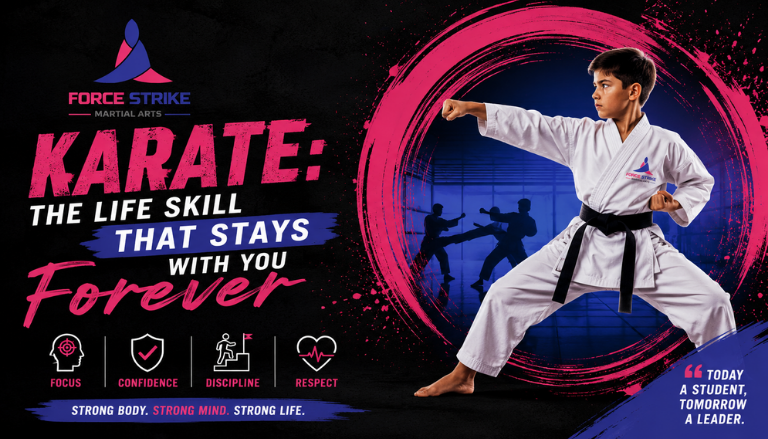
Some activities you do for a season. You play football as a child, stop somewhere in your twenties, and carry a general fitness base forward. You learn to swim and use it occasionally. These things are useful, but they're finite.
Karate is different. People who train seriously — even for a few years — carry something forward that doesn't fade the way a specific skill does. The posture changes. The composure under pressure changes. The ability to focus in difficult moments, to persist through frustration, to show up consistently when results aren't visible — these don't live in the muscles. They live in the way a person approaches things.
It's not marketing jargon for a Karate Academy. It's a phenomenon that has been seen over the years with practitioners, coaches, and researchers in martial arts development, in both cultures and age groups. The particular needs of Karate training cause changes to be permanent.
The obvious outputs of karate training are physical. Improved flexibility, coordination, cardiovascular fitness, strength. These are real and they develop progressively with consistent practice.
But the physical outputs aren't what separates karate from other forms of exercise. Most well-structured fitness activities produce similar physical results. What's specific to karate — and to martial arts more broadly — is the mental and character development that happens as a byproduct of how the training is structured.
Karate is learned through repetition of precise technique. The same kata is performed hundreds, then thousands of times. Not to achieve perfection, exactly, but to approach it — to close the gap between current execution and correct execution through deliberate practice. This process teaches something that almost no school subject or childhood activity teaches as directly: how to stay with something difficult and imprecise for a long time without external reward.
That capacity — to persist with uncertain progress toward a clear standard — is one of the most transferable skills a person can develop. It shows up in academic performance, in professional settings, in how people handle setbacks. Not because karate is magic, but because the training repeatedly places practitioners in the specific conditions that build it.
The grading system in karate is sometimes dismissed as a commercial mechanism — a way for academies to generate additional revenue and keep students motivated through novelty. That criticism has some validity at poorly run academies where grades are awarded loosely.
At a properly structured programme, the belt system serves a genuinely developmental function. Each grade represents a demonstrated competency standard, assessed by a qualified examiner, that the student must earn through preparation rather than simply time served.
For children especially, this creates repeated experiences of a specific kind. The grading examination is approaching. The material isn't ready. More practice is required. The examination arrives, the student performs, and the outcome reflects their preparation. In most contexts, adults and academics in their working roles, this cycle is repeated several times: prepare, assess, outcome. Children who repeatedly see this cycle in a low-stakes realm are the ones that get ready to deal with it when the stakes are raised.
A kid who doesn't make a belt grade but then discovers something from a coach, now trains differently and passes a belt grade, has learned something that a kid who passed a belt grade without first discovering it has never had the opportunity to learn. This is not a coincidence of what happens in Karate Classes in Arjan Dubai. At the heart of its value in development.
The formal culture of a karate dojo — bowing when entering, addressing instructors with respect, maintaining focus during instruction, acknowledging training partners — is sometimes seen as ceremonial or old-fashioned. From a developmental psychology perspective, it's something more practical.
Habits are established by repetition in a given context and then transferred to another context. It's the same with a child that bows at the entrance to the training space 500 times, listens without interrupting 200 times and acknowledges corrections of an authority figure without argument 300 times, it doesn't stay on the mat.
Teachers notice this. Parents notice it. The child who trains karate regularly will hear differently in school, obey differently at home and deal differently with peer conflict in the playground. Not because karate taught them to act in a particular way outside the dojo, but because they were able to develop the ability to do that in the dojo.
This is the mechanism behind the discipline outcomes that parents consistently report in children who train martial arts. It's not philosophical — it's repetition producing habit, habit producing character.
Adults who start karate — often after years of conventional gym training — frequently describe a different kind of engagement. The gym provides a physical challenge. Karate provides a physical challenge with a cognitive and emotional dimension that doesn't exist in weight training or cardio.
Running on a treadmill or lifting weights allows the mind to wander. A karate session doesn't. The technique must be attended to. The partner must be read. The kata must be remembered and executed precisely. For adults managing high-pressure professional environments, this forced mental presence is often described as the most valuable part of training — an hour where the week's accumulated stress simply doesn't fit alongside the concentration required.
The self-defence dimension develops gradually but genuinely. Not in the dramatic action-film sense — in the practical sense that trained practitioners understand distance, manage physical space differently, and carry a quiet awareness that changes how they move through unfamiliar situations. This is particularly meaningful for residents in a large international city like Dubai, where physical confidence carries everyday practical value.
There's also something harder to quantify that adults who train for several years often describe. A sense of continuity with a practice that is genuinely theirs. Job titles change. Relationships change. The city they live in may change. The kata they've spent three years learning doesn't. There's a groundedness in having a skill that belongs to the practitioner independently of any external context.
Karate isn't superior to other martial arts in any absolute sense. BJJ, Muay Thai, taekwondo, and judo all produce genuine character development outcomes through their own structural mechanisms. The case for karate specifically rests on a few qualities that distinguish it from the alternatives.
The kata tradition is one. No other mainstream martial art places the same emphasis on solo practice of structured movement sequences. The kata in karate is a complete practice in itself — it develops body awareness, memorisation, focus, and precision in a format that requires no partner and can be practiced anywhere. A black belt in karate can train meaningfully in a living room. That accessibility makes long-term practice realistic in a way that partner-dependent martial arts sometimes aren't.
The formal structure of traditional karate is another. The emphasis on precise technique, the belt system, the dojo culture — these create the specific conditions that produce the developmental outcomes described throughout this article. Some practitioners prefer less formal environments, and that's legitimate. But for children and for adults who benefit from clear expectations and visible progression, the structure is a feature rather than an obstacle.
The physical demands are also broadly accessible. Karate is one of the few martial arts that can be trained productively from age four through to well into later adulthood. The physical intensities are scalable in a way that more contact-heavy disciplines sometimes aren't, making it viable as a long-term practice rather than something that requires a young and robust body.
The outcomes that Karate Classes Near Me produces vary meaningfully depending on when someone trains and for how long.
Children (ages 4–12): The primary developmental gains are focus, discipline, frustration tolerance, physical coordination, and the habit of showing up. Technical karate skill is secondary to the character development at this stage, even if the sessions are focused on technique. A child who trains for three years between ages six and nine carries those character gains into adolescence regardless of whether they continue training.
Teenagers: The self-confidence dimension becomes particularly important. Adolescence involves significant social pressure and identity formation. A teenager who has a practice that is genuinely their own — that earns them respect through demonstrated skill rather than social performance — has a source of confidence that doesn't depend on peer approval. The self-defence capability is also more relevant at this stage than in early childhood.
Adults: The mental clarity, stress relief, and physical maintenance dimensions tend to dominate. For working parents managing demanding schedules in communities like Arjan, Al Barsha, or Business Bay, two to three karate sessions per week provide physical conditioning alongside the cognitive reset that sustained technical practice produces.
Long-term practitioners: Something qualitatively different emerges after years of consistent training. The practice becomes integrated into identity rather than being an activity the person does. This is the dimension most difficult to explain to someone who hasn't experienced it, and the most common thing that long-term karate practitioners describe when asked what they've gained.
Not all karate programmes produce the outcomes described in this article. The developmental benefits depend significantly on programme structure, coaching quality, and the culture of the specific academy.
Families looking for karate classes in Dubai — whether in Arjan, JVC, Al Barsha, or elsewhere — should look for academies where the coaching approach emphasises technique and character development equally, where age groups are properly separated, where belt progression is earned through genuine assessment, and where the culture models the values that karate training is meant to build.
Forcestrike Martial Arts in Arjan offers structured karate programmes for both children and adults, with an emphasis on the foundational development that makes long-term practice possible. Visiting the academy, observing a class, and speaking with the coaching team before enrolling gives the most accurate picture of whether the environment suits your child or yourself.
If you're considering karate for your child or for yourself in Arjan or the surrounding Dubai communities, Forcestrike Martial Arts welcomes visits to observe sessions and speak with the coaching team. The first-hand experience of watching a class tells you more than any article — including this one.
When are children ready to learn karate?
The majority of structured Karate programmes start at age 4 or 5 years. Formal training in belt-track starts at about 6 to 7 years old, when the attention span and fine motor development are more appropriate for learning belt-track techniques.
How long does it take to see the life-skill benefits of karate training?
Physical fitness improvements show within the first month. Character development outcomes — improved focus, frustration tolerance, and discipline — typically become visible to parents and teachers after three to four months of consistent training.
Is karate safe for children?
At a properly supervised academy with age-appropriate instruction, yes. Contact is introduced gradually and is always supervised. The physical risks at beginner and intermediate level are comparable to those of most childhood sports, provided training is age-appropriate.
Can adults benefit from karate or is it mainly for children?
Adults gain significantly from karate training. The mental clarity, physical conditioning, self-defence awareness, and stress relief benefits are particularly relevant for working adults. Many adults report karate as the most consistently engaging fitness practice they've sustained long-term.
Why is karate better than fitness for kids in the gym?
Karate teaches physical literacy (coordination, balance and body control) in addition to character traits (discipline and resilience). Children's fitness usually comes from the gym program rather than the martial arts program, and is not structured, developed, or refined in the same way as martial arts fitness.