.png)


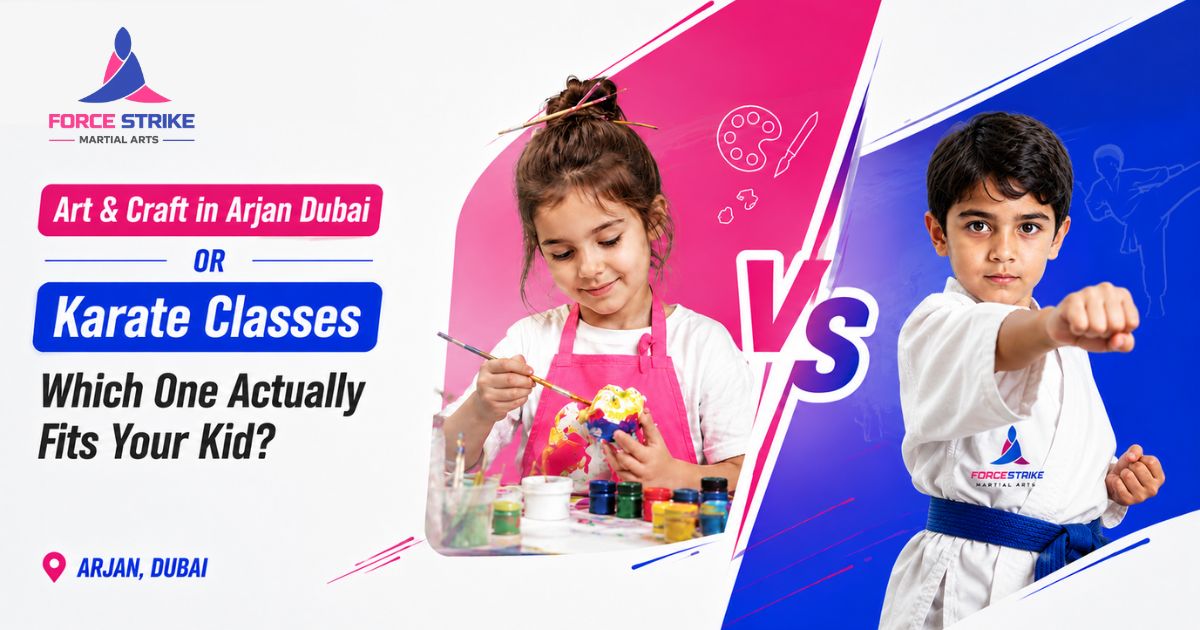
"Should we do art, or should we do karate?" I've heard some version of this question from at least a dozen Arjan parents over the past year, usually asked at pickup time, usually with a slightly tired look on their face. There isn't a clean answer. Anyone who tells you one activity is objectively better hasn't actually watched enough kids try both.
What I can tell you, after sitting in on classes and talking to instructors on both sides, is that the "right" choice has almost nothing to do with which activity looks better on paper. It has to do with your specific kid. Their energy, their patience level, whether they need somewhere to burn off steam or somewhere to slow down. So let's actually get into it — properly, not the surface-level version you'll find on most listicles, and not the same generic roundup of art classes in Dubai that gets recycled on every parenting blog.
Art & Craft programmes around Arjan are creative sessions — paint, clay, paper, recycled bits and pieces, sometimes digital tools thrown in — aimed at building fine motor skills and letting kids make something with their hands. Good ones are themed and progressive. A term might move from basic shape work to a full mixed-media project by week eight. Bad ones are basically glorified babysitting with crayons. More on spotting the difference later.
Karate Classes in Arjan Dubai are the opposite kind of structure. Discipline-first, belt-based, built around physical coordination and self-defense fundamentals. In and around Arjan, there are a handful of dojos worth knowing about, and Forcestrike Martial Arts comes up a lot when parents talk about kids-specific programmes — partly because their coaching is built for children from day one rather than being an adult class watered down.
Both count as after school programmes in the loosest sense. Both get kids off screens. That's basically where the similarities end.
Arjan's grown fast. Anyone who's lived there more than two years has watched new towers go up practically overnight, and with all those families moving in, there's real demand for activities close to home — not a 40-minute drive to Downtown for a one-hour class.
There's also the screen time thing. Every parent I talk to bring it up unprompted, which tells you something. Both art and martial arts pull kids away from tablets for an hour, but they do it in completely different ways — one through quiet focus, the other through physical exertion. And in a city where a lot of kids get fairly independent fairly early (walking to a friend's building alone, hanging around community parks), a decent chunk of parents like the idea of their kid having some baseline self-defense awareness. That's not a small factor in the karate decision, honestly.
Art & Craft tends to build:
Karate tends to build:
I keep coming back to one example. A shy seven-year-old, painfully quiet, the kind who won't make eye contact with adults. In an art room, surrounded by open-ended creative work, she opens up almost immediately. Put a different shy kid — a boy, similar age — into karate, and something else happens: an older student, a black belt, still bows to him with full respect during drills. That small moment does more for some kids' confidence than a dozen pep talks ever could. Different mechanisms, same outcome.
A parent told me art class basically saved her daughter's homework routine. Not because art fixed some deep focus problem — it didn't — but because for one hour a week, nobody was rushing her. She got to sit with something until it was done, at her own pace. That patience, apparently, started showing up at the kitchen table a few months later.
Then there's the opposite story. A nine-year-old boy, described by his own mother as "impossible to slow down," started karate twice a week at a dojo near Arjan. Bowing in, following commands, waiting his turn to spar — all that structure gave his energy somewhere to actually go. His teachers noticed a change in classroom behaviour within a single term. Not magic. Just structure meeting a kid who needed it.
There's also a longer-term angle worth mentioning. Kids leaning toward design, architecture, even coding — spatial-logical thinking shows up more than people expect — tend to benefit from early creative work. Karate's payoff shows up differently: general fitness, readiness for competitive sports later, and for a lot of parents, plain peace of mind that their child could handle themselves physically if it ever came to that.
|
Factor |
Art & Craft |
Karate |
|
Physical intensity |
Low to moderate |
High |
|
Best suited for |
Creative, quieter, or expressive kids |
Energetic kids who respond well to structure |
|
Core skill |
Fine motor + creative thinking |
Discipline + physical coordination |
|
Class dynamic |
Collaborative, flexible |
Hierarchical, respect-based |
|
Session length |
Usually 45–60 minutes |
Usually 45–60 minutes |
|
Progression |
Project or portfolio-based |
Belt-based |
|
Starting age |
3+ |
Usually 4+, varies by dojo |
If you're aiming to calm an anxious kid down or nurture a creative streak, art wins. If discipline, fitness, or self-defense readiness is the goal, karate wins. Plenty of Arjan families just do both on alternating days — more common than you'd think, and it works fine logistically for most weekly schedules.
Art classes: the biggest complaint I hear is inconsistent instructor quality. Some programmes genuinely build skills term over term. Others are closer to unsupervised free play with a paintbrush thrown in. Ask directly, before signing up, what specific techniques get covered over eight weeks. If the answer's vague, that tells you something.
Karate: the recurring issue is instructors who are great with adults but not actually trained to hold a five-year-old's attention. Being a strong martial artist doesn't automatically make someone good at teaching kids. This is part of why academies running dedicated children's programmes — Forcestrike Martial Arts being one example — tend to get better feedback from parents. The coaching is designed for kids from the start, not adapted on the fly mid-class.
Trial class, always. Nearly every decent programme in Arjan offers one, whether it's art or martial arts, so there's rarely a reason to skip it. Watch how your kid behaves during and right after — not just whether they say they "had fun." Genuine engagement looks different from a kid being polite.
Talk to instructors directly before committing to anything longer. A good art teacher can tell you, specifically, what your child will learn over the next eight weeks. A good karate instructor can walk you through the belt system clearly and explain, in plain terms, how they handle discipline with young kids.
And if you genuinely can't decide — don't. A two-day art, two-day karate split each week is increasingly normal among Arjan families. It's not overloading a schedule, and it gives kids exposure to both without forcing a choice nobody's ready to make yet.
Hybrid programmes are becoming a real trend — studios bundling creative and physical activities under one membership instead of making parents pick a lane. Scheduling has loosened up too, with more evening and weekend slots opening specifically around Arjan as the population there has kept climbing.
On the martial arts side, there's growing demand for female instructors teaching kids' karate, and academies including Forcestrike Martial Arts have expanded female-led sessions in response. On the art side, sustainability-themed craft is having a moment — recycled materials, eco-art projects, nature-based work — which tracks with the broader shift happening in Dubai schools around environmental education.
There isn't a universal winner here, and I'd be lying if I pretended otherwise. Art builds patience, creativity, fine motor skills. Karate builds discipline, fitness, and physical confidence. The actual answer comes down to your child's temperament, your family's weekly rhythm, and — honestly — what your kid is genuinely excited to walk into each week. A lot of Arjan families land on the same conclusion eventually: don't force a choice. Let both get a fair trial, and let your child's own enthusiasm settle it.
If you're weighing art & craft in Arjan Dubai against kids' karate classes with an academy like Forcestrike Martial Arts, the simplest next step is booking a trial for each. Watch, don't overthink it — you'll know within a session or two which one your child actually gravitates toward.
Is art or karate better for a shy child?
Art tends to be gentler at first, but plenty of quiet kids come out of their shell in karate too, thanks to its respect-based structure. Try both before deciding.
What age can kids start karate in Dubai?
Most academies take children from around age 4, though some run modified programmes for kids as young as 3.
Can a child do both art and karate?
Yes, and it's increasingly common — many Arjan families split the week between the two.
Is karate safe for young kids?
Reputable kids' programmes, including those at Forcestrike Martial Arts, focus on control and supervised practice, not heavy contact sparring.
How do I find good art classes for kids near me in Arjan?
Look for a clear curriculum, a trial class option, and instructors trained in child development rather than just fine art technique.